


A banking website has one job before it does anything else:
Make people trust you.
Not admire you.
Not clap for your gradient.
Not whisper, “Wow, those cards have really tasteful shadows.”
Trust you.
That is the whole game.
Whether the company is a bank, fintech startup, investment banking firm, M&A advisor, private equity firm, lending platform, wealth manager, or corporate finance consultancy, the website is not just a nice digital brochure. It is a brand trust system.
And in financial services, trust is not a soft feeling floating somewhere in the clouds wearing linen pants.
Trust is commercial infrastructure.
It affects whether people contact you, whether investors take you seriously, whether founders share confidential information, whether clients believe you can handle their money, whether partners see you as credible, and whether your brand feels established enough to survive due diligence.
A banking website is not simply a design project.
It is a brand strategy project with a website attached to it.
That is where many businesses get it wrong.
They ask for a “modern banking website” and end up with the same safe navy homepage, generic headline, three service cards, some smiling stock-photo executives, and a CTA button that says “Learn More” like it has given up on life.
That is not brand strategy.
That is financial wallpaper.
A proper banking website needs to do more. It needs to position the business, clarify the offer, reduce perceived risk, signal credibility, and guide the visitor toward a serious next step.
That is the real assignment.
The Website Is Not the Brand. It Is the Brand Being Judged.
Your banking website is often the first place people quietly judge whether your company is serious.
That judgment happens fast.
Before they read your services.
Before they look at your team.
Before they book a call.
Before they understand your process.
They feel the brand.
And in finance, that first feeling usually lands somewhere between:
“This feels credible.”
Or:
“Something is off.”
That “something is off” feeling is deadly.
It does not always come from one obvious mistake. It usually comes from a stack of small signals:
Weak typography.
Generic copy.
Messy spacing.
Unclear positioning.
Too many visual effects.
Stock photography that looks fake.
A CTA that does not match the decision.
Colors that feel copied from every fintech template since 2018.
A homepage that says “innovative financial solutions” but never explains what the business actually does.
None of these alone may destroy trust.
Together, they make the brand feel unserious.
And in banking, finance, and investment services, “unserious” is not a cute little branding flaw.
It is a conversion killer.
Banking Website Design Starts With Brand Strategy
Before designing a banking website, you need to answer a few brand questions.
Not design questions.
Brand questions.
Who does this business need to be trusted by?
What type of financial decision is the visitor making?
What level of risk does the visitor feel?
What does the visitor need to believe before taking action?
What category codes does the brand need to respect?
Where does the brand need to feel traditional?
Where does it need to feel modern?
What makes this company specific?
What must the website communicate in the first five seconds?
These answers matter more than whether the hero section uses a photo, abstract graphic, or product UI.
Because the design direction should come from the trust problem.
A fintech app helping young users manage subscriptions has a different trust problem than a boutique M&A advisory firm helping founders sell software companies.
A private bank serving high-net-worth families has a different trust problem than a lending platform serving small businesses.
A corporate finance advisor has a different trust problem than a neobank trying to win consumer adoption.
If the strategy is vague, the website becomes vague.
And vague banking websites are everywhere.
They say things like:
“Empowering your financial future.”
“Your trusted partner for growth.”
“Financial solutions for a changing world.”
“Where innovation meets excellence.”
Lovely. Also, almost completely meaningless.
If you removed the logo, that copy could belong to a bank, a SaaS platform, a law firm, an insurance company, or a motivational seminar held in a hotel conference room with suspicious coffee.
A strong banking website should not be interchangeable.
It should be unmistakably built around the business, its audience, its market, and its credibility signals.
The Biggest Mistake: Designing for the Industry Instead of the Position
A lot of banking websites look the same because everyone designs for the industry.
Finance equals navy.
Trust equals serif.
Technology equals blue.
Premium equals whitespace.
Innovation equals gradient.
There is nothing wrong with those ingredients. They work for a reason. But ingredients are not a recipe.
The goal is not to make something that “looks finance.”
The goal is to make the brand feel correctly positioned inside finance.
That distinction matters.
A boutique investment bank should not look like a retail bank.
A fintech startup should not look like a private wealth office.
A lending platform should not look like an M&A advisory firm.
A wealth management brand should not look like a crypto dashboard that escaped supervision.
Each one has a different business model, buyer psychology, sales process, and credibility requirement.
So before the design starts, the positioning needs to be clear.
For example:
A boutique Tech M&A bank needs to feel discreet, specialized, senior, and transaction-ready.
A fintech payment platform needs to feel secure, fast, simple, and technically reliable.
A private banking firm needs to feel stable, refined, personal, and discreet.
A lending company needs to feel clear, fair, transparent, and easy to understand.
A financial consulting firm needs to feel analytical, experienced, and commercially sharp.
That positioning should shape the whole website.
The copy.
The typography.
The navigation.
The CTA.
The photography.
The section order.
The proof points.
The amount of motion.
The color behavior.
The tone of voice.
Everything.
Otherwise, you are not building a brand.
You are decorating a category.
Competitor References Are Not Design Instructions
Clients often say:
“We want something like these competitors.”
This is where things get interesting.
Most people hear that and think:
“Okay, copy the competitor layout.”
Wrong move.
Competitor references are not always visual instructions. They are often perception references.
The client is usually pointing to a feeling.
They might not have the language to say:
“We want to feel more institutional.”
“We need to look safer.”
“We want to feel like we belong in the same category.”
“We want the same level of credibility.”
“We want to look serious enough for bigger clients.”
So they point at a competitor and say:
“Like this.”
Your job is not to copy the website.
Your job is to decode what that website is doing to perception.
What does it signal?
Authority?
Scale?
Stability?
Innovation?
Discretion?
Luxury?
Technical competence?
Institutional maturity?
That is the useful part.
For a banking or finance website, competitor analysis should focus on three layers.
Layer 1: Category Codes
These are the expected signals in the industry.
In finance, common category codes include:
Clear hierarchy.
Controlled color palettes.
Strong typography.
Credible service framing.
Professional photography.
Minimal visual noise.
Trust-focused copy.
Team credibility.
Compliance-aware language.
Proof points.
Market insight content.
These codes help visitors quickly understand what world the brand belongs to.
Layer 2: Emotional Signals
This is what the website makes the visitor feel.
For example:
“This firm is established.”
“This bank is safe.”
“This fintech is simple.”
“This advisor understands my market.”
“This wealth firm is discreet.”
“This company is not experimenting with my money.”
That emotional response is usually the real reason the client likes a reference.
Layer 3: Differentiation Opportunity
This is where the brand can avoid becoming a copycat.
You ask:
What can we borrow emotionally without copying visually?
What can we improve?
What feels stale in the category?
What should this brand own?
What does the market expect, and where can we be sharper?
That is the strategic design opportunity.
Because a good banking website should feel category-appropriate, but not generic.
It should belong in the room without dressing exactly like everyone else at the table.
Trust Signals Are the Real Design System
When people think of a design system, they usually think of buttons, colors, typography, spacing, and components.
That matters.
But in banking, trust signals are also part of the design system.
They need to be intentionally built into the website.
Trust signals can include:
Clear positioning.
Specific service language.
Leadership credibility.
Market specialization.
Years of experience.
Transaction volume.
Client types.
Regulatory clarity.
Security messaging.
Testimonials, when appropriate.
Case studies, when possible.
Market insights.
Process transparency.
Strong contact pathways.
Professional photography.
Restraint in visual language.
Notice something?
Not all trust signals are logos or numbers.
Sometimes the most important trust signal is clarity.
If a visitor immediately understands what you do, who you serve, and what happens next, they feel safer.
If they have to decode vague copy and scroll through decorative sections, trust drops.
In finance, confusion creates friction.
Clarity creates confidence.
That is why brand strategy and UX are not separate here. They are tied together.
The Hero Section Has to Stop Being Vague
The hero section is where many banking websites commit crimes against clarity.
A weak banking hero says:
“Empowering Financial Growth Through Innovation.”
That says nothing.
It sounds polished, but it does not position the company.
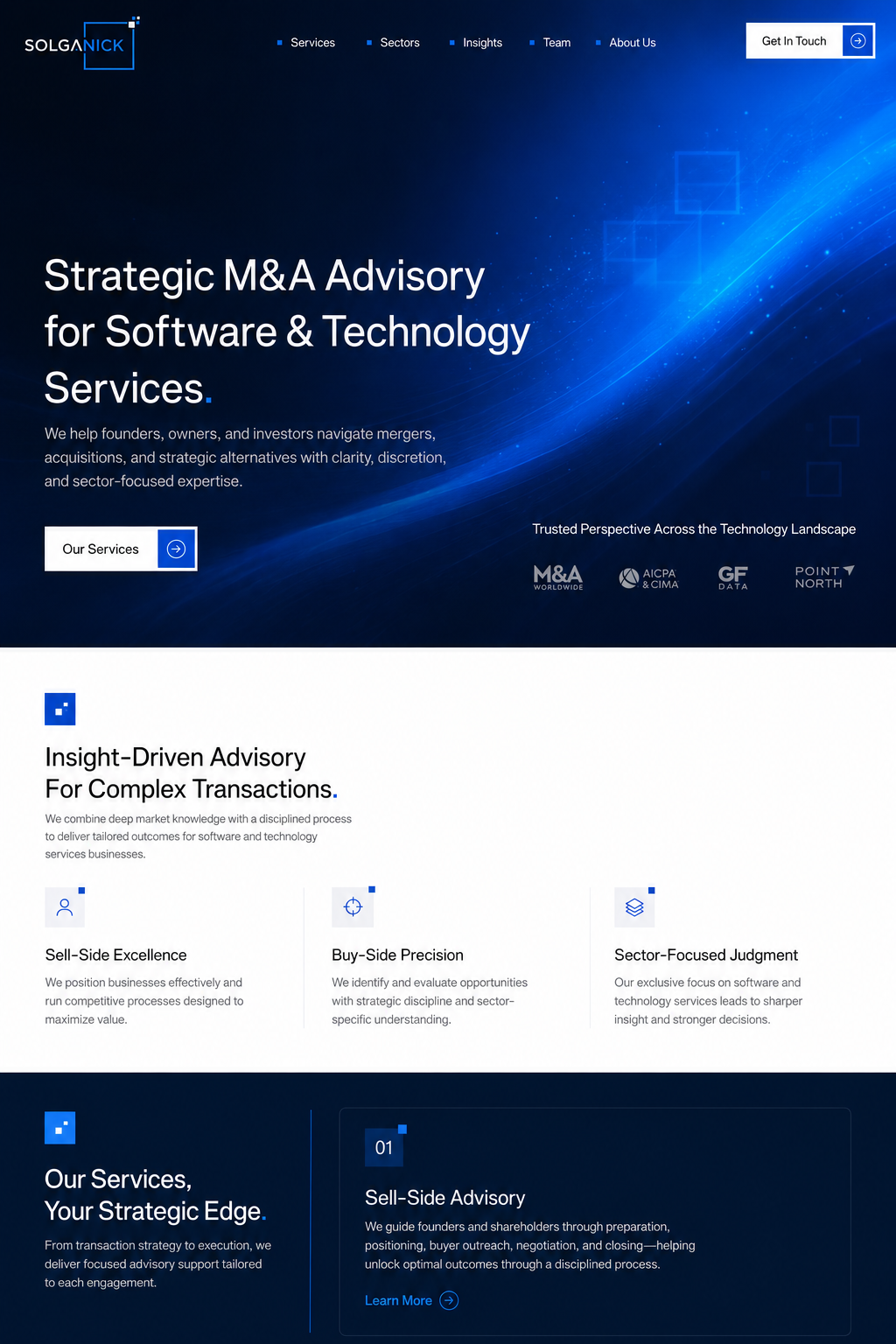
A stronger hero says:
“Strategic M&A Advisory for Software and Technology Services Companies.”
Now we know what the company does.
Who it serves.
What category it belongs to.
Why the visitor should keep reading.
That is a proper hero.
The best banking website headlines usually do one of four things:
1. Define the Service Clearly
Example:
“Private Banking for Families, Founders, and Long-Term Wealth.”
2. Define the Market Clearly
Example:
“M&A Advisory for Software and Technology Services Companies.”
3. Define the Outcome Clearly
Example:
“Clearer Lending Decisions for Growing Businesses.”
4. Define the Position Clearly
Example:
“A Boutique Corporate Finance Partner for Founder-Led Companies.”
The point is simple.
Do not make the visitor guess.
If someone has to read four sections before understanding what the financial business does, the homepage has already lost control.
The CTA Should Match the Level of Decision
CTA copy is not just button text.
It tells the visitor what kind of action they are taking.
That matters in finance.
A fintech app can say:
“Open an Account.”
A banking app can say:
“Start Banking.”
A private wealth firm can say:
“Schedule a Private Consultation.”
An M&A advisory firm can say:
“Start a Confidential Conversation.”
A lending platform can say:
“Check Eligibility.”
A financial advisor can say:
“Speak With an Advisor.”
Each CTA carries a different psychological weight.
“Get Started” is fine for low-risk actions.
But for high-trust financial services, it can feel too casual.
If someone is considering selling their company, moving wealth, borrowing capital, or choosing an advisory partner, the CTA should respect the seriousness of that decision.
The words should reduce friction, not create pressure.
That is why CTA language should be part of the brand strategy.
Not an afterthought added after the page is designed.
The Visual Style Should Reduce Risk
Banking website visuals should support the trust goal.
That does not mean every finance site needs to be boring. Please no. The world has suffered enough gray rectangles.
But the design should feel controlled.
Control is a trust signal.
That usually means:
Consistent spacing.
Strong alignment.
Limited color usage.
Readable typography.
Clear section rhythm.
Subtle motion.
Careful image selection.
No random decorative chaos.
No unnecessary gimmicks.
No interface elements that look like they were stolen from a crypto presale page.
The website should feel like someone is in charge.
For many financial brands, restraint is more powerful than flash.
That is hard for some businesses to accept because they think restraint means dull.
It does not.
Restraint means confidence.
It means the brand does not need to shout to be taken seriously.
A good banking website should feel like a well-tailored suit.
Not a billboard outside a casino.
Photography Matters More Than People Think
Photography can make or break a banking website.
Bad finance photography is painfully easy to spot.
The handshake.
The boardroom.
The fake laughing meeting.
The person pointing at a chart that means nothing.
The laptop coffee shot.
The skyscraper reflection.
The “diverse team looking thoughtfully at glass wall” special.
These images do not build trust anymore. They build suspicion.
Good banking photography should feel intentional.
Depending on the brand, that could mean:
Architectural photography.
Founder portraits.
Editorial team photography.
Abstract market imagery.
Product UI.
Workplace detail shots.
City-specific imagery.
Subtle documentary-style photography.
Premium still-life compositions.
The key is relevance.
For a boutique investment bank, photography should feel discreet, intelligent, and senior.
For a fintech app, visuals might focus on product clarity and user confidence.
For a private wealth firm, imagery might lean toward calm, continuity, and personal relationship.
For a lending platform, photography might show real business context.
Photography should not be filler.
It should be part of the brand language.
Service Sections Should Be Built Around Buyer Questions
Many finance websites list services like they are reading from an internal menu.
That is not enough.
Service sections should answer what the buyer is actually wondering.
For example, a boutique M&A advisory firm should not simply list:
Sell-side advisory.
Buy-side advisory.
Valuation.
Strategic advisory.
That is fine, but it needs framing.
The visitor wants to know:
Can you help me prepare?
Can you position the company properly?
Can you reach the right buyers?
Can you protect confidentiality?
Can you help me understand value?
Can you guide negotiation?
Can you close?
So the service section should connect the service to the buyer’s concern.
Instead of:
“Sell-Side Advisory”
You can frame it as:
“Sell-Side Advisory: Position, prepare, and run a disciplined process designed to maximize value.”
That is clearer.
The title tells them the service.
The description tells them why it matters.
Sector Focus Is a Credibility Multiplier
Finance brands often try to sound broad because they fear narrowing their audience.
But in many cases, specificity increases credibility.
If you are a Tech M&A bank, say technology.
If you work with founder-led companies, say founder-led.
If you specialize in healthcare finance, say healthcare.
If you support SMEs, say SMEs.
If you help professional services firms, say that.
The more specific the audience, the easier it is for the visitor to think:
“These people understand my situation.”
That is what a strong brand does.
It creates recognition.
Not everyone needs to feel like the brand is for them.
The right people need to feel like it is unmistakably for them.
A Banking Website Needs a Narrative, Not Just Sections
A common mistake is thinking a homepage is just a stack of components.
Hero.
Services.
About.
Testimonials.
FAQ.
CTA.
Done.
That is structure, but it is not narrative.
A proper banking website should move the visitor through a sequence.
For example:
- This is who we are.
- This is who we help.
- This is the problem we solve.
- This is why our approach is credible.
- This is how we help.
- This is why you can trust us.
- This is what happens next.
That sequence creates confidence.
It is similar to how a business plan or brand strategy works.
You do not throw everything onto the page and hope the visitor assembles meaning like IKEA furniture with missing screws.
You guide them.
That is the difference between a website that looks nice and a website that sells trust.
The Brand Guidelines Should Cover Trust Behavior
For banking and finance brands, brand guidelines should go beyond logos and colors.
They should include:
Tone of voice.
Headline rules.
CTA language.
Photography principles.
Proof-point usage.
Compliance-sensitive language.
Data and statistics usage.
How to describe services.
How to write about risk.
How to present team credibility.
How to use testimonials.
How to handle market insights.
How to maintain visual restraint.
Because in finance, inconsistency weakens trust.
If the homepage is polished but the service pages sound like generic corporate soup, the brand breaks.
If the website feels premium but the downloadable PDF looks like a Word document that survived a minor accident, the brand breaks.
If the visual system is elegant but the social posts are loud and random, the brand breaks.
Trust is cumulative.
So the brand system needs rules.
Not because rules are glamorous.
Because rules keep the brand from slowly turning into a junk drawer.
What a Strong Banking Brand Website Should Include
A strong banking or finance website usually needs:
Clear Positioning
Who are you?
What do you do?
Who do you serve?
Why should this audience care?
Strong Visual Identity
A color system, typography system, image style, and layout logic that support the brand position.
Service Clarity
Clear explanation of what the company offers and how those services map to client needs.
Trust Signals
Proof, credibility, process, leadership, specialization, security, or authority signals.
Audience Relevance
The visitor should quickly understand whether the firm works with people or businesses like them.
Thought Leadership
Market insights, guides, reports, articles, or commentary that show expertise.
Strong CTA
A next step that feels natural for the type of financial decision.
Consistent Brand System
Reusable design and content rules so the brand does not fall apart across pages, decks, PDFs, ads, and campaigns.
That last point is important.
Because the website is only one part of the brand.
A banking company also needs presentation decks, sales materials, reports, one-pagers, investor documents, email sequences, social presence, and sometimes product interfaces.
If the website is strong but the rest of the brand is inconsistent, trust leaks out.
Slowly.
Quietly.
Annoyingly.
Like a subscription you forgot to cancel.
The BBDirector Way to Think About It
The way to approach a banking website is not:
“Let’s make a nice homepage.”
The better approach is:
“Let’s build a brand system that makes this financial company easier to trust.”
That means connecting:
Brand strategy.
Visual identity.
Messaging.
Website structure.
Content.
Marketing.
Development.
Guidelines.
Conversion flow.
A banking website is strongest when all those pieces work together.
The homepage should not be disconnected from the brand strategy.
The colors should not be disconnected from the audience.
The copy should not be disconnected from the sales process.
The CTA should not be disconnected from the decision.
The design should not be disconnected from the credibility problem.
That is why banking website projects should be treated as brand-building projects, not just UI projects.
Practical Framework: The Banking Website Trust Stack
Here is a simple way to think about it.
1. Positioning Trust
The visitor understands what the company does and who it serves.
2. Visual Trust
The design feels controlled, credible, and appropriate for the financial category.
3. Language Trust
The copy is specific, clear, and free of empty corporate fluff.
4. Proof Trust
The site includes relevant credibility signals, such as experience, process, specialization, insights, security, or leadership.
5. Journey Trust
The page structure guides the visitor logically toward the next step.
6. System Trust
The brand remains consistent across the website, guidelines, marketing materials, and sales assets.
If one layer is weak, the whole experience suffers.
A beautiful website with vague positioning will not convert properly.
Strong copy inside weak design will feel underpowered.
Good services with no proof will feel risky.
A great homepage with inconsistent follow-up materials will create doubt.
Trust needs the whole stack.
Banking Website Strategy Checklist
Before designing or redesigning a banking website, answer these questions:
Who is the primary audience?
What financial decision are they considering?
What are they afraid of?
What do they need to believe before contacting us?
What makes the brand credible?
What makes the brand different?
What category expectations do we need to respect?
Where can we modernize without losing trust?
What proof can we show?
What proof can we not show because of confidentiality or regulation?
What should the CTA be?
What tone of voice fits the brand?
What visual direction reduces risk?
What content should support authority?
What should the user understand in five seconds?
If those questions are unanswered, the website brief is not ready.
You can still design something nice.
But nice is not enough.
Especially when money is involved.
Final Thought: Banking Websites Are Built on Belief
A banking website is not just about services.
It is about belief.
The visitor has to believe the company is competent.
They have to believe it understands the market.
They have to believe it can protect their interests.
They have to believe it is serious.
They have to believe the next step is worth taking.
That belief does not come from one headline or one button.
It comes from the entire system.
The strategy.
The design.
The copy.
The structure.
The proof.
The tone.
The consistency.
That is why banking website design should start with brand strategy.
Because in finance, the brand is not there to decorate the business.
The brand is there to make trust visible.
And once you understand that, the website becomes much more than a homepage.
It becomes a credibility engine.