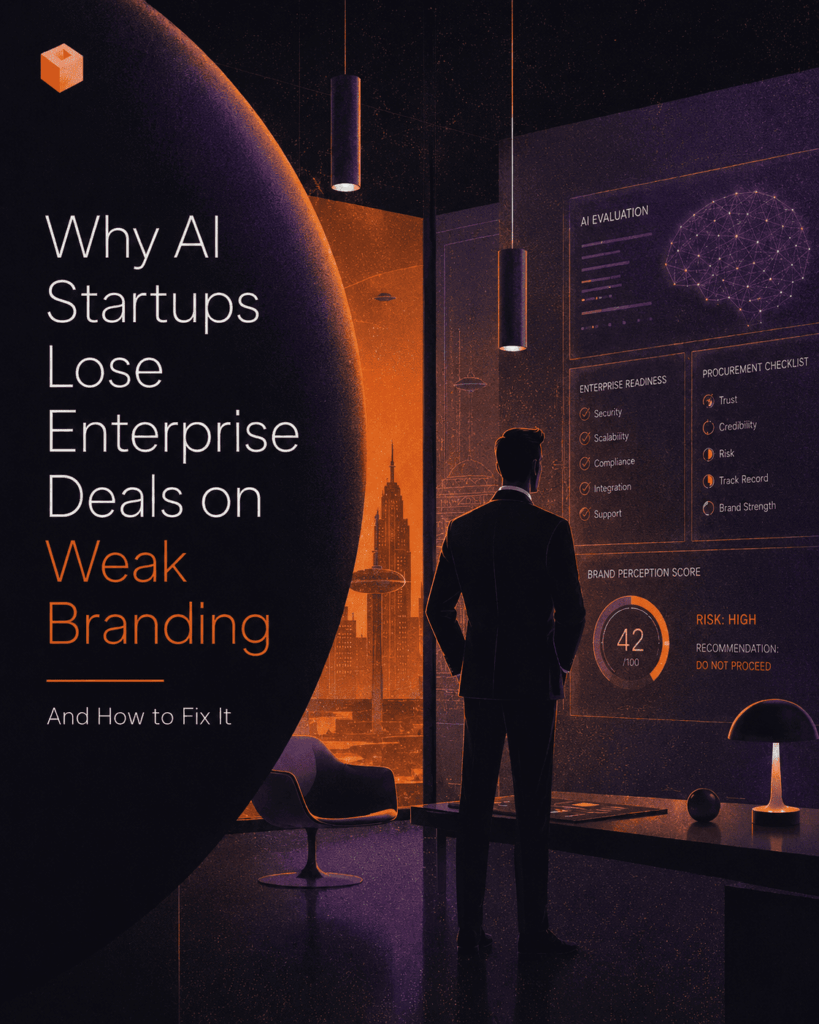


Your AI product works. Your demos impress. Your pilots deliver results.
And yet the deal dies somewhere between “we love this” and a signed contract.
If you’re an AI founder selling into enterprise, you’ve likely felt this exact friction. The technology isn’t the problem. The perception of your company is.
After 13+ years of building brands for companies in complex, regulated, and high-stakes industries, I’ve watched this pattern repeat across dozens of AI and deeptech startups. They build extraordinary technology, then wrap it in a brand that signals “we’re still figuring things out.” And enterprise buyers — the ones writing six- and seven-figure checks — notice every signal.
Here’s what’s actually happening, why it matters more in 2026 than ever before, and a framework to fix it.
The Enterprise Trust Gap Nobody Talks About
Enterprise buyers are not evaluating your AI on technical merit alone. They’re evaluating risk.
This is why medical device companies face the same trust gap: the product may be technically sound, clinically useful, and backed by real expertise, but buyers still need the brand to signal safety, maturity, compliance, and institutional reliability before they move forward.
A VP who champions your tool internally is asking themselves one question: “If I push for this and it fails, can I defend that decision to my CFO, my board, and the three people in procurement who didn’t want to change vendors?”
This is why interest doesn’t convert. Forrester’s 2026 State of Business Buying report — based on surveys of nearly 18,000 global B2B buyers — found that trust has become the ultimate currency in enterprise purchasing. The days of persuasive pitch decks are fading. Buyers demand transparency, validation, and measurable proof before they move.
Your brand is where that trust evaluation starts. Before the demo. Before the pilot. Often before the first call.
This is not limited to AI either — deeptech companies face the same branding challenge when their technology is advanced, but their market-facing story makes enterprise buyers work too hard to understand why they should trust it.
Your Brand Gets Evaluated Before You Enter the Room
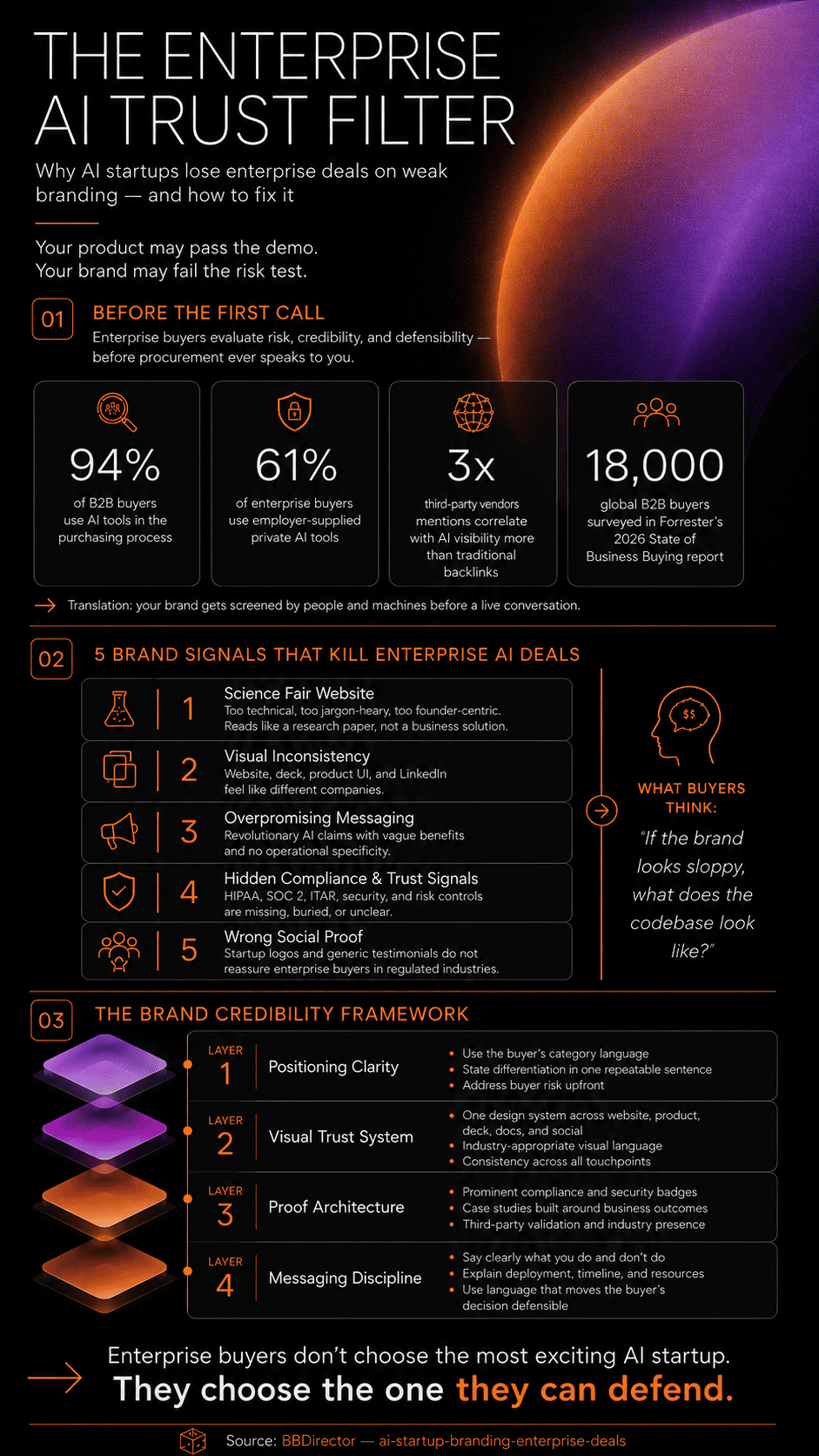
Here’s the shift most AI founders haven’t absorbed yet: in 2026, 94% of B2B buyers use AI tools in their purchasing process. Generative AI and conversational search have become the single most meaningful information source across every phase of buying — outpacing vendor websites, sales reps, and product experts combined.
What does that mean practically? Your buyer’s organization has an AI agent provisioned with company data and research tools. That agent runs before procurement opens a formal process. Before your SDR’s outreach. Before the first discovery call.
By the time a human from your buyer’s team picks up the phone, an AI system has already been asked some version of: “Who are the credible options in this category?”
And here’s the kicker: research from Ahrefs analyzing 75,000 brands found that brand web mentions in third-party sources correlate with AI Overview visibility at 3x the rate of traditional backlinks. The signal that moves AI purchasing systems isn’t your website’s SEO — it’s your brand’s presence and credibility across the broader web.
If your brand looks like a weekend project — inconsistent visuals, generic messaging, a website that screams “seed-stage startup” — you get filtered out before a human ever sees your name. This is exactly how generative AI is reshaping branding and procurement across high-stakes industries.
The Five Brand Signals That Kill Enterprise AI Deals
After working with companies across aerospace, defense, medical devices, energy infrastructure, and AI, I’ve identified the specific brand failures that consistently stall or kill enterprise deals.
1. The “Science Fair” Website
Your homepage leads with technical architecture diagrams, model benchmarks, and jargon that only your engineering team understands. The implicit message: “We built something cool and we’re excited about the technology.”
Enterprise buyers don’t buy technology. They buy solutions to business problems with manageable risk profiles. When your website reads like a research paper, you’re signaling that you don’t understand how enterprises make purchasing decisions.
The fix: Lead with the business outcome. What does the buyer’s world look like after they deploy your product? Technical depth belongs in documentation, not on your homepage. The latest web design trends all point in the same direction: clarity and trust over complexity.
2. Visual Inconsistency Across Touchpoints
Your pitch deck uses one color palette. Your website uses another. Your product UI feels like a different company entirely. Your LinkedIn content looks like it was designed by four different people (because it was).
In regulated industries — defense, healthcare, financial services — visual consistency isn’t aesthetic preference. It’s a proxy for operational discipline. If you can’t maintain a coherent brand across five touchpoints, procurement teams wonder what your codebase looks like. That’s why building a cohesive brand identity across your website, sales materials, product, and content matters long before you start worrying about making individual assets prettier.
The fix: Invest in a design system before you scale your sales team. A consistent visual language across every touchpoint — from your website to your proposal templates to your product UI — signals the operational maturity that enterprise buyers are screening for. This is one of the most common visual branding mistakes that cost firms trust and credibility.
3. Messaging That Overpromises and Underspecifies
“Revolutionary AI that transforms your business.” “The future of [industry].” “AI-powered everything.”
Enterprise buyers in regulated markets have been burned by overpromising vendors. They’re allergic to it. PwC’s Digital Trust report found that over 85% of users in regulated markets said trust in digital services directly influenced their adoption decisions — and trust is built through specificity, not superlatives.
When your messaging sounds like every other AI startup, you’re not differentiating. You’re blending into the noise that procurement teams are trained to filter out.
The fix: Be specific about what your product does, what it doesn’t do, and what the boundaries are. “Our NLP model processes regulatory filings in 23 languages with 97.3% accuracy, reducing compliance review time by 40%” wins deals. “Revolutionary AI platform” loses them.
4. No Visible Compliance or Trust Architecture
You’re selling into healthcare and there’s no mention of HIPAA on your website. You’re targeting defense contractors and ITAR doesn’t appear anywhere in your materials. You’re approaching financial services and SOC 2 is buried in a FAQ.
In regulated industries, compliance isn’t a footnote — it’s a prerequisite. And if it’s not visible in your brand materials, buyers assume it doesn’t exist. There are specific trust signals every high-stakes website must display — and most AI startups miss them entirely.
The fix: Make compliance and security certifications prominent in your brand architecture. Not as legal disclaimers, but as trust signals. Create dedicated pages or sections that demonstrate your understanding of the regulatory environment your buyers operate in.
5. No Social Proof From Their Universe
You have logos on your website, but they’re all from other startups. Your case studies feature companies your enterprise prospect has never heard of. Your testimonials come from individual users, not from the VPs of Engineering or Heads of Compliance who match your buyer persona.
Enterprise buyers in critical industries evaluate vendors through the lens of: “Has this company successfully served organizations like mine?” Generic social proof doesn’t answer that question.
The fix: Build case studies and proof points that speak directly to your target industry segments. If you don’t have enterprise logos yet, use detailed use-case narratives that demonstrate deep understanding of the buyer’s operational environment — the constraints they face, the workflows they run, the compliance requirements they navigate daily.
The Brand Credibility Framework for AI Companies
Fixing this isn’t about hiring a branding agency to make your website prettier. It’s about building a brand architecture that systematically addresses the trust barriers enterprise buyers face.
Here’s the framework I use with AI and deeptech companies:
Layer 1: Positioning Clarity
- Define your category in terms the buyer already uses. Don’t invent a new category unless you have the marketing budget to educate the market (you probably don’t).
- State your differentiation in one sentence that a non-technical VP can repeat in an internal meeting.
- Identify the risk your buyer faces in choosing you, and address it preemptively in your positioning.
Layer 2: Visual Trust System
- Design system that scales across all touchpoints — website, product, presentations, documentation, social.
- Industry-appropriate visual language. Defense and infrastructure brands need gravitas. Biotech brands need precision and clarity. AI brands need to balance innovation with stability. You can see how biotech companies approach brand strategy when the product carries a similar mix of technical complexity, long buying cycles, and high trust requirements.
- Consistency audit. Every touchpoint a prospect encounters should feel like the same company built it.
Layer 3: Proof Architecture
- Compliance and security badges prominently placed, not hidden in footers.
- Case studies structured around business outcomes, not technical implementation.
- Third-party validation — analyst mentions, industry publications, conference presence — that feeds the AI systems your buyers use to research vendors.
- Content that demonstrates domain expertise in the buyer’s industry, not just in your technology.
Layer 4: Messaging Discipline
- Capability boundaries — what you do and don’t do — stated clearly.
- Implementation narrative — what the deployment actually looks like, timeline, resources required.
- Risk containment language — how you help the buyer make a defensible decision.
Once those foundations are in place, choosing the right branding model for your growth stage becomes much easier. Some companies need strategic brand work first; others already have the system and mainly need consistent execution.
Why This Matters More in 2026
The convergence of two trends has made brand credibility the single highest-leverage investment for AI companies selling into enterprise:
First, AI-powered procurement is now standard. When AI agents evaluate vendors, they’re synthesizing brand signals from across the web. A weak brand doesn’t just hurt when a human visits your website — it hurts across every AI-mediated touchpoint in the buyer’s journey. Forrester found that 61% of enterprise buyers use private AI tools supplied by their employers in the purchasing process. Your brand needs to be legible to machines, not just humans.
Second, the AI market is consolidating. The sheer volume of AI startups means enterprise buyers are overwhelmed with options. Brand credibility has become the primary filter. When a procurement team has 30 vendors that all claim to solve the same problem, they start eliminating based on perceived maturity, trustworthiness, and professional presentation. Your brand is your first and most powerful differentiation tool. Companies that understand how to reposition as innovation leaders consistently outperform those relying on product specs alone.
The AI startups that will win enterprise contracts in the next 18 months aren’t necessarily the ones with the best models. They’re the ones that look like companies enterprise buyers can trust with critical infrastructure.
The Bottom Line
If your AI company has a strong product but stalling enterprise sales, the problem likely isn’t your technology, your pricing, or your sales team. It’s the gap between what your company actually is and what your brand communicates.
Enterprise buyers in critical industries — defense, healthcare, energy, financial services — are making high-stakes decisions. They’re betting their careers on vendor choices. And they’re using every available signal, human and AI-mediated, to determine which vendors are worth that bet.
A brand that signals maturity, domain expertise, compliance awareness, and operational discipline doesn’t just make you look good. It makes the buyer’s decision defensible. And in enterprise sales, a defensible decision is the only kind that gets made.
At BBDirector, we build brands for companies operating in complex, high-stakes industries — from AI and deeptech to aerospace, defense, and critical infrastructure. If your technology is ready for enterprise but your brand isn’t, explore our design-on-demand services and let’s close that gap.