



The aerospace and defense industry has no shortage of technical competence. What it frequently lacks is an equally disciplined way of explaining that competence to the people who decide whether it deserves a contract, a partnership, a place in a supply chain or serious attention from an investor.
Aerospace and defense companies operate in one of the few markets where a technically superior product can still struggle commercially because the company behind it is poorly positioned, difficult to understand or indistinguishable from twelve competitors using the same vocabulary about innovation, mission readiness and next-generation capability. The engineering may be exceptional; the message sometimes arrives wearing camouflage.
This is where brand strategy becomes commercially useful. Aerospace marketing should not make serious technology sound lightweight, nor should it turn national security, aviation or complex aerospace engineering into glossy advertising language. Deep tech companies do not need to be dumbed down; they need to be translated. In aerospace and defense, that translation needs to preserve technical credibility while making the company’s position, relevance, proof and competitive advantage easier for a decision-maker to understand.
This guide explains how to do that across positioning, procurement, market research, AI, supplier relationships, thought leadership, content marketing, business development and long-term market expansion.

What Does Brand Strategy Actually Need to Do in the Aerospace and Defense Industry?
A brand in the aerospace and defense industry has a harder job than simply generating brand awareness. It has to make technical capability legible across several audiences that evaluate the company through very different criteria. Engineers may care about performance specifications, a procurement team about risk and delivery, an investor about market size and defensibility, a prime contractor about integration and supply chain reliability, while government stakeholders may be considering mission relevance, compliance, political scrutiny and national security at the same time.
This is why a useful deep tech brand strategy begins with translation rather than promotion. The company needs one underlying strategic position, but that position must be capable of producing different levels of explanation without becoming a different story every time the audience changes. A sensor manufacturer, software supplier, propulsion company or autonomous aviation business should be able to explain what it does to an engineer, program manager and investor without forcing all three to sit through the same technical presentation.
The brand therefore acts as an organising system for commercial meaning. It defines what the company should become known for, why that position is credible, which proof supports it and how the message should change according to context. When that work is done well, products and services become easier to evaluate because the market understands not only what the company produces, but what role it is capable of playing inside a larger aerospace and defense ecosystem.
How Should Aerospace Marketing Position a Contractor Before Procurement Even Begins?
Most companies start thinking seriously about communication when there is an active opportunity, request for information, trade show, procurement process or sales conversation. By then, much of the reputational work should already have happened. A buyer who first encounters your positioning while reviewing a proposal is being asked to understand the company and evaluate the offer simultaneously, which is an unnecessarily expensive way to introduce yourself.
Strong aerospace brand positioning answers several questions before procurement begins: what category the company belongs to, which problem it is unusually well equipped to solve, who it solves that problem for, why its approach is different, and what evidence makes that difference believable. This is more useful than a positioning statement built from interchangeable claims about innovation, excellence, customer focus and advanced technology, because every contractor can make those claims and most already have.
Aerospace marketing should also distinguish between technical differentiation and market differentiation. A company may possess a genuinely novel engineering capability but still occupy an undifferentiated commercial position because its message describes features rather than consequences. The buyer does not merely need to know that your platform performs optimization using AI; they need to understand whether that capability reduces planning time, improves reliability, increases operational visibility or allows an existing defense program to achieve something that was previously difficult or uneconomical.
That translation creates a competitive edge because it gives the market a clearer reason to remember the company. The goal is not to sound simpler than competitors; it is to be understood faster and with fewer opportunities for the buyer to misunderstand what makes you valuable.
What Should Market Research Tell You About the Decision-Maker, Procurement and the Supply Chain?
Market research in this sector should go much further than estimating market size and listing competitors. Aerospace and defense companies need to understand how decisions are actually made, which stakeholders influence them, what risks each stakeholder is trying to avoid, where the budget sits, how long procurement takes, which supplier relationships matter and what must be true before somebody is comfortable recommending a new company internally.
That often means mapping several audiences rather than inventing one neat customer persona. A technical decision-maker may be evaluating compatibility and performance while a commercial team examines cost and schedule, procurement evaluates supplier risk, executives assess strategic relevance and an external partner considers how your capability affects its own position with the customer. In longer defense deals, the company may also need to communicate with people who never become direct buyers but materially influence whether an opportunity progresses.
The supply chain adds another layer. A small supplier selling into prime contractors does not need the same brand strategy as a prime selling directly to the Department of Defense, nor does a commercial aerospace company expanding into national defense need to behave as though the two buying systems are identical. Market research should identify these differences before the brand architecture, messaging hierarchy and marketing strategies are built.
Useful research therefore combines buyer interviews, competitor analysis, industry publications, tender and procurement patterns, partner conversations, sales-loss analysis and observation of industry trends. An aerospace and defense industry outlook or a Deloitte report can provide useful macro context, but neither can tell you why a particular buyer hesitated after your second meeting. The closer the research gets to real commercial behaviour, the more useful it becomes.
How Should Aerospace and Defense Companies Translate AI and Innovation Into a Credible Message?
AI has become one of those terms that can mean something significant or almost nothing, depending on the paragraph surrounding it. Within the aerospace and defense industry, it can refer to autonomy, predictive maintenance, intelligence analysis, design optimization, mission planning, manufacturing, logistics, sensing, decision support or dozens of other applications. Simply attaching AI to the company description therefore creates very little useful differentiation.
A brand strategy should connect AI and other defense technologies to a specific operational consequence. Instead of leading with the technical label, explain what becomes possible because the capability exists, who benefits, what constraint is removed and why the approach is credible. If an AI system reduces analysis time, increases mission awareness or improves the performance of an existing process, that commercial and operational meaning should arrive before an extended explanation of the architecture.
The same principle applies to aerospace innovation more broadly. Research and development matters enormously, but R&D is not itself a market position. Innovation in aerospace becomes strategically valuable when the company can connect technological progress to a meaningful customer outcome and demonstrate why its capability can survive deployment, regulation, integration and scale.
This is where aerospace storytelling frameworks become useful. The strongest technical story usually moves from market or mission context to problem, consequence, new capability, evidence and larger implication. That structure gives technical depth somewhere useful to go instead of making the audience dig through it hoping to discover why the company matters.
How Do Defense Companies Build Trust Before a Procurement Process Starts?

Trust in the defense market is built through accumulated evidence rather than a paragraph announcing that the company is trustworthy. Defense companies are evaluated through delivery history, technical credibility, compliance, leadership, supplier quality, partner relationships, security posture, program experience and the consistency of their public and private communication. A brand can organise and amplify those signals, but it cannot manufacture them from nothing.
This is why defense company branding should concentrate heavily on proof. If the company has worked on a defense program, completed difficult testing, collaborated with respected partners, achieved certifications, reduced deployment risk or built unusually strong engineering capability, those facts should become part of the communication system instead of being buried in a PDF nobody reaches until meeting three.
Your digital presence matters here as well. B2B buyers research suppliers online long before every formal conversation, which means an outdated or vague website can introduce doubt even when the actual company is highly capable. The most useful trust signals for aerospace and defense websites include clear capabilities, specific use cases, evidence, leadership credibility, technical documentation, certifications, program context and a believable explanation of how the organisation works.
The principle is straightforward: if a buyer needs to take professional risk by choosing an unfamiliar supplier, the brand should systematically reduce the number of unanswered questions surrounding that decision.
How Should a Supplier Build a Brand That Prime Contractors and Strategic Partners Understand?
Smaller aerospace companies often describe themselves as though the objective is to appear as large as possible. The better objective is to appear unusually clear about the value they contribute. Prime contractors rarely need every supplier to present itself as a miniature version of a global defense corporation; they need to understand the capability, reliability, integration value and circumstances under which bringing that supplier into a program improves the overall outcome.
A supplier position should therefore be built around role clarity. Are you the specialist who solves a difficult engineering problem, accelerates development, reduces weight, improves production quality, adds a capability to an existing platform or provides a faster route around a known constraint? The more specific that role becomes, the easier it is for business development teams and strategic partners to understand where the company fits.
Partnership communication also matters because aerospace and defense products are rarely developed or delivered by one organisation operating alone. The partnership itself can become a trust signal when the relationship demonstrates compatibility, validation or access to capability that would be difficult to reproduce independently. This is particularly useful for smaller firms attempting to enter a complex supply chain where reputation travels through networks long before a marketing campaign reaches anyone important.
The brand should therefore help the company explain not only what it sells, but why it is a useful organisation to work with. That distinction matters in a market where a technically attractive supplier can still lose momentum if buyers expect integration pain, communication problems or commercial immaturity.
What Role Should Thought Leadership and Content Marketing Play in Aerospace Marketing?

Content marketing in aerospace and defense should make expertise visible, not simply keep LinkedIn occupied on Tuesdays. Technical companies often have enormous amounts of knowledge inside engineering, product and leadership teams but publish very little of it in a form that buyers, analysts, partners or investors can use. When content does appear, it is frequently either so technical that only peers can follow it or so generic that there was little reason for the company to publish it.
Useful industry content sits between those extremes. It can explain a change in technology, interpret procurement implications, examine a difficult operational problem, compare approaches, comment on competitive dynamics or show why an apparently technical development has broader market consequences. The objective is not to turn engineers into lifestyle influencers; civilization has enough problems. It is to give the market evidence that the company understands the problem space beyond the boundaries of its own product.
Thought leadership also supports business development because good content gives a decision-maker a reason to encounter the company before an active buying cycle. A useful technical article can be shared internally, cited by industry publications, discussed at industry events or used by sales teams as evidence during a conversation. Over time, this improves brand awareness among the people who actually matter rather than chasing the largest possible audience.
Digital channels should support that strategy rather than dictate it. LinkedIn, email, the corporate website, public relations, industry conferences and a trade show all perform different roles. Strong marketing strategies decide what message each channel needs to carry while preserving the same underlying market position.
How Should Visual Identity Support Aerospace Engineering Rather Than Decorate It?
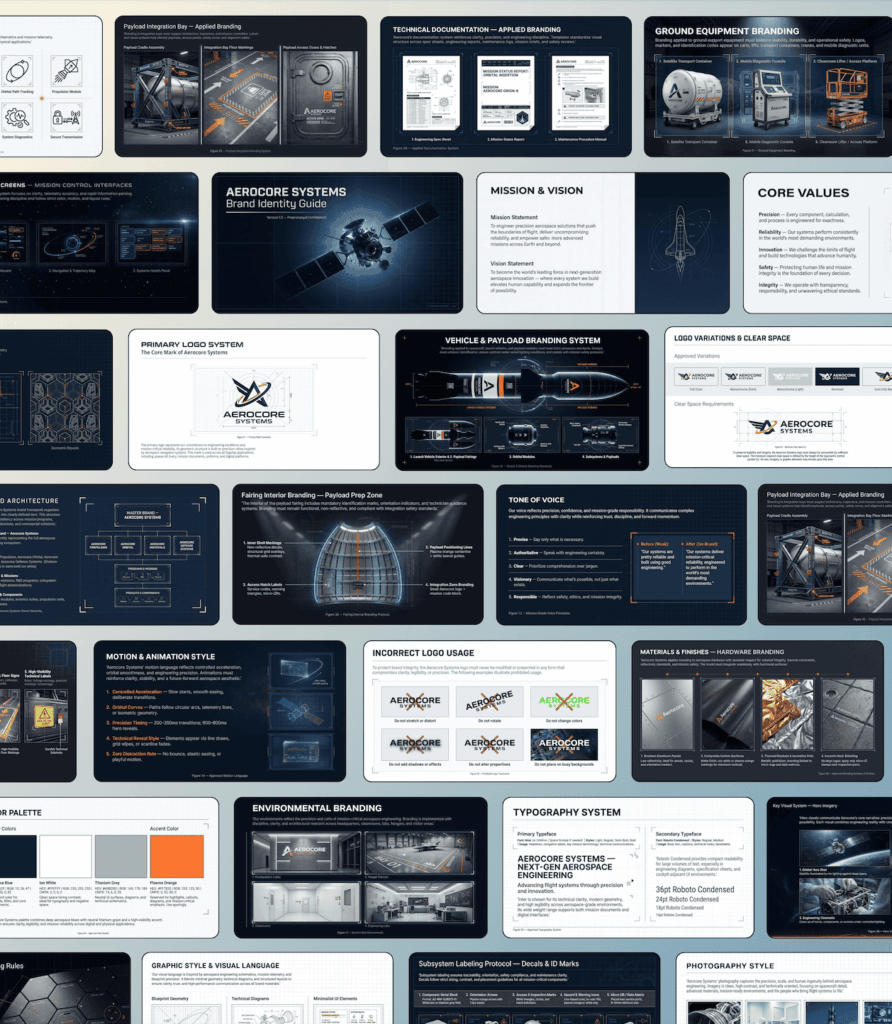
Visual identity in this sector is often pulled between two equally unhelpful extremes: corporate anonymity on one side and science-fiction cosplay on the other. One produces blue gradients, generic sans serifs and a logo that could belong to an insurance company; the other produces glowing orbital lines, tactical geometry and enough visual futurism to suggest the engineering team has relocated to a videogame menu.
A stronger system begins with strategy. The identity should reinforce the company’s position by making qualities such as precision, technical sophistication, reliability, scale, speed or specialist expertise visible without depending on clichés. Typography, colour, diagrams, photography, motion and information design should help the audience process complicated material rather than merely decorate it.
Looking at leading aerospace and defense brands is useful precisely because successful visual systems are rarely interchangeable. Different companies encode scale, heritage, engineering authority, mission orientation and innovation differently because their competitive positions are different.
For companies actively developing their identity, a broader cohesive visual identity should work across technical documents, proposals, websites, pitch material, recruitment, investor communication and industry events. A brand system that survives only on a homepage mock-up is not much of a system.
How Do Industry Events, Partnerships and Business Development Work Together?

Industry events remain unusually important in aerospace and defense because relationships, physical demonstrations and reputation still carry substantial weight. Conferences associated with organisations such as the National Defense Industrial Association, specialised technical forums, aviation events and a major trade show can bring together procurement teams, prime contractors, suppliers, analysts and potential partners in a concentrated environment that digital marketing cannot perfectly reproduce.
The mistake is treating the event as a booth-design problem rather than a business development moment. The company should decide in advance what position it wants to reinforce, which audiences matter, which proof needs to be visible and what conversation it wants people to continue after the event. Marketing services can produce an excellent stand, but they cannot rescue an organisation whose entire message is “come and see our exciting innovations.”
The most effective event strategy therefore connects pre-event content, meeting outreach, the physical presence, product demonstrations, thought leadership, public relations and post-event follow-up. It should also create useful signals for people who never attended, because photographs, presentations, video, press coverage and industry insights can extend the event far beyond the exhibition floor.
Partnership announcements deserve similar discipline. Rather than simply declaring that two companies are “excited to announce” something, explain what capability the partnership creates, why it matters to customers and what it says about each company’s strategic direction. That is how partnership activity begins to strengthen the brand instead of merely filling the news page.
What Do Case Studies of Aerospace and Defense Companies Actually Teach About Brand Strategy?
Case studies are useful when they reveal a principle rather than turning established corporations into objects of worship. Lockheed Martin, Boeing, Northrop Grumman and other industry leaders have very different histories, portfolios, commercial models and reputational challenges, so there is little value in copying their surface behaviour. A smaller contractor imitating the language of a multinational prime tends to look like exactly what it is: a smaller contractor imitating a multinational prime.
The useful lesson from established aerospace and defense companies is that market position is built over time through a relationship between capability, proof, narrative and repeated behaviour. Companies associated with particular defense systems, commercial aerospace platforms, advanced programs or specialist domains benefit because the market connects the name with accumulated evidence. The brand is not detached from operational performance; it is the structure through which that performance becomes reputation.
The original version of this article used Lockheed Martin to illustrate technical leadership, Boeing to discuss adaptability across commercial and defense aviation, and Northrop Grumman to explore stakeholder relationships. Those are still useful lenses, but the more important lesson is that a brand strategy needs to amplify what the organisation can consistently prove rather than borrow the tone of industry leaders without the evidence underneath it.
When developing case studies for your own company, focus on the problem, operating context, constraint, approach, result and proof. A vague paragraph about “delivering innovative solutions” adds very little. A specific account of how aerospace engineering solved a difficult production problem, reduced program risk or enabled an important capability gives the buyer something concrete to remember.
How Should Brand Strategy Respond to the Aerospace and Defense Industry Outlook Without Chasing Every Trend?
An aerospace and defense industry outlook can help leadership understand changing investment priorities, global defense spending, commercial aerospace demand, digital transformation, emerging AI applications and changes in the supply chain. The difficulty begins when every industry trend is immediately promoted into the brand message, leaving the company sounding as though it has changed direction every time someone downloads a new report.
A brand should adapt when the underlying market changes, not merely because the vocabulary has changed. If defense priorities shift toward autonomy, resilient systems, software integration or another capability directly connected to what the company can credibly deliver, the position may need refinement. If a popular term has little connection to the actual product, inserting it into every page will not accelerate growth; it will simply make the website more fashionable and less believable.
The same applies to AI. Optimization, simulation, autonomous systems and analytics may become central to the business, but the brand still needs to explain why those capabilities matter in context. The strategic question is always what changed for the buyer, what new demand emerged, and whether the organisation has enough evidence to own the new position.
This is where brand strategy becomes a long-term management discipline rather than a rebranding exercise. Leadership should periodically review market research, sales feedback, procurement changes, partner conversations, industry conferences, competitive movement and performance data, then decide whether the existing position still describes where the company is strongest.
The objective is not to maximize the number of themes attached to the company. It is to preserve a clear market meaning while the organisation develops.
The Aerospace and Defense Brand Strategy Framework to Remember
- Start with position rather than promotion. Aerospace marketing becomes much more effective when the market can clearly understand what the company does, for whom, and why its approach deserves consideration.
- Translate technical capability into operational and commercial meaning. Engineering depth should remain available, but it should support the message rather than bury it.
- Understand the entire decision system. Procurement, technical teams, program leadership, prime contractors, strategic partners and investors may all evaluate the same company differently.
- Build proof into the brand before an active procurement cycle begins. Certifications, partnerships, program experience, technical evidence, leadership credibility and case studies reduce perceived risk.
- Treat the supply chain as part of the brand environment. A supplier needs to explain how it strengthens the larger program, not merely list what it manufactures.
- Use AI and technological innovation carefully. The market needs to understand the consequence of the technology, not simply see fashionable terminology attached to it.
- Make thought leadership useful. Industry content should demonstrate market understanding and technical credibility rather than exist to satisfy a publishing calendar.
- Build visual identity from the strategic position. Aerospace and defense companies need distinctive, usable systems, not generic corporate blue or theatrical futurism.
- Connect industry events to business development. Trade shows, industry conferences, public relations and digital channels should reinforce the same strategic position.
- Learn principles from industry leaders rather than copying their language. Reputation grows when repeated proof and communication create a clear association in the market.
- Adapt to meaningful industry change without chasing every trend. A strong strategy evolves as capabilities, procurement and market conditions change while protecting the company’s core meaning.
- Remember the central rule: aerospace and defense companies do not need their technology dumbed down; they need it translated so the right decision-maker can understand why it matters, believe the evidence and know where the company fits.
When we think of the aerospace and defense industry, images of cutting-edge technology, military might, and sky-high ambitions naturally spring to mind.
Yet, there’s an unsung hero in this sector’s saga of success – brand strategy.
For aerospace and defense companies, crafting a compelling brand strategy isn’t just about logos and slogans; it’s about embedding your ethos into the industry’s fabric and resonating with a global audience.
Consider this – recent studies have shown a significant correlation between robust brand strategies and market dominance in the aerospace and defense sector. Companies with clearly defined and effectively communicated brand strategies are not only more likely to secure contracts but also to be perceived as pioneers in technological advancement and reliability.
In this comprehensive guide, we delve into the essentials of creating a winning brand strategy for aerospace and defense companies.