


The Gulf War did not invent media influence, television warfare or government information management. What it did was compress them into a new operating environment. In January 1991, audiences could follow events from Baghdad with a speed and continuity that previous conflicts had not delivered at comparable global scale, and CNN became the symbol of that shift.
The result was bigger than a successful news format. Coverage of the Gulf War changed expectations about war information, accelerated the relationship between military action and television news, and created a new problem for governments: perception could now move almost as quickly as events themselves.
For defense and deep-tech companies, the lesson is not that war should be treated like advertising. It is that complex capability is always interpreted through a narrative layer. Deep tech companies do not need to be dumbed down; they need to be translated. The same was true of military technology in the Gulf War. Precision weapons, air power, briefings, maps and live images became understandable to the public because media coverage connected technical capability with a visible account of what was happening.
This article looks at CNN coverage, the CNN effect, television reporting from Baghdad, restrictions on journalists, military briefings, competing interpretations and the transition from the first Gulf War to the fragmented media system that followed.
How Did the Gulf War Become a Turning Point for CNN and Television Coverage?
The immediate Gulf crisis began when Iraq invaded Kuwait in August 1990. Iraqi president Saddam Hussein’s decision triggered an international confrontation, followed by a coalition buildup involving the United States, Saudi Arabia and other partners. Between 1990 and January 1991, the buildup to the war itself became a major news event before coalition combat operations began.
When the war began on January 17, 1991, Operation Desert Storm opened with an intensive air campaign against Iraqi targets. CNN had reporters in Baghdad and was able to provide live coverage while much of the world was still accustomed to scheduled nightly news and evening news summaries. The cable news network had already existed for a decade, but the conflict provided an event large enough to demonstrate the value of its continuous model.
That difference was strategically important for the news organization. Television coverage had influenced public understanding of conflict long before the 1991 Gulf War, but audiences no longer needed to wait for the next scheduled bulletin. Watching CNN became a way of following developments as they unfolded.
During the Gulf crisis, CNN therefore became more than another outlet carrying news coverage. Its continuous coverage created a distinctive global position for the network and changed what audiences began expecting from television news.
What Made CNN’s Live Coverage From Baghdad So Different?
One of the defining moments came from CNN correspondents Bernard Shaw, Peter Arnett and John Holliman reporting from Baghdad as coalition air operations began.
The important change was immediacy.
A reporter was no longer necessarily reconstructing events several hours later for a packaged broadcast. A journalist could describe what was being heard and observed while the situation remained unresolved. CNN live reporting from Baghdad gave audiences a sense of temporal proximity to the conflict even though access to the battlefield itself remained heavily restricted.
That live war coverage changed the competitive standard for television. A traditional news network could still provide reporting, verification and analysis, but the advantage of speed was suddenly impossible to ignore. CBS News and other established broadcasters continued to matter, yet CNN coverage demonstrated what a 24-hour news organization could do when a major geopolitical event did not respect the timetable of the evening news.
This was groundbreaking coverage in the context of global cable television. CNN’s coverage of the Gulf helped establish the expectation that significant events should be available continuously rather than summarized later.
The media coverage of the Gulf was becoming part of the experience of the event itself.
What Was the CNN Effect, and Did Media Coverage Really Influence Policy?
The phrase CNN effect came to describe the idea that rapid television reporting could increase political pressure by putting images and events before policymakers and the public faster than traditional government communication systems could comfortably respond.
The theory needs some restraint.
It does not mean that every decision during the Gulf War was caused by television. Military strategy, diplomacy, domestic politics, alliance management and intelligence all operated according to their own pressures. The role of the media is better understood as part of the decision environment rather than a remote control for foreign policy.
But timing mattered.
CNN’s live coverage, Iraqi statements, coalition briefings and rapidly circulating images reduced the distance between an event and the public reaction to it. Real-time news coverage compressed the communication cycle.
That meant leaders increasingly had to consider not only what was happening, but what people believed was happening while events were still developing.
For modern defense communication, that principle remains useful. Visibility changes the operating environment. Once information moves quickly, silence, contradiction and uncertainty acquire meaning of their own.
How Did Restrictions on Press Coverage Shape Gulf War Coverage?
The Gulf War was highly visible, but visibility was not the same thing as unrestricted journalism.
Restrictions on press coverage and the media pool system affected where many reporters could travel, what they could observe independently and how quickly information could reach audiences. This created one of the defining contradictions of 1991 Gulf War coverage: viewers experienced unprecedented immediacy while journalists still faced substantial restrictions on access.
Television could show briefings, selected strike footage, interviews, reports from Baghdad and images from Saudi Arabia, but the ground war did not receive the same continuous independent visibility.
That shaped the view of the war.
Military officials also understood that war information had strategic consequences. Briefings, maps, videos and prepared explanations gave the coalition a structured way to describe the war effort and reinforce themes of organisation, precision and operational control.
Critics questioned whether mainstream media coverage relied too heavily on those official frames. Alternative media and later analysis also focused on the constraints created by the pool system.
A journalist could still challenge official statements, but what a reporter was physically able to observe affected the evidence available for doing so.
This distinction matters when analysing the media rather than merely criticising or celebrating it: perception depends not only on what somebody says, but also on what the audience is permitted to see.
How Did the Media Frame the War as High-Tech, Precise and Controlled?
One of the strongest visual themes associated with the Persian Gulf War was technological precision.
Television audiences saw strike footage, missile trajectories, aircraft, Patriot interceptors and briefing-room presentations that repeatedly emphasised advanced military technology. Iraqi forces, coalition air power and the wider campaign were often explained through systems, targets and measurable operational outcomes.
In parts of television coverage, the media framed the war as an exciting narrative built around smart weapons, speed and technological superiority. That framing did not represent every aspect of the conflict, but it became highly memorable.
This mattered for the defense industry because systems previously known mainly to military specialists entered everyday conversation.
The broadcast media did not have to run an ad for a weapons manufacturer for particular technologies to acquire a public identity. Repetition, imagery and commentary created visibility around the machines associated with the conflict.
For modern defense businesses, the relevant lesson is not to seek battlefield spectacle. It is to understand how technical capability becomes meaningful when audiences can connect it with an outcome.
Our guide to defense company branding applies the same principle commercially: sophisticated technology becomes strategically valuable when the decision-maker understands what changes because the technology exists.
How Was Coverage of the First Gulf War Different From the Vietnam War?
The Vietnam War comparison is useful because both conflicts became strongly associated with television, but the media environments were fundamentally different.
Vietnam entered American homes through television reporting and nightly broadcasts, but not through continuous global satellite television in the 1991 sense. Images were recorded, edited and transmitted with delay. Over time, reporting on casualties, destruction, political disagreement and the progress of the conflict contributed to an increasingly contested domestic understanding of the war and significant opposition to the war.
Coverage of the first Gulf War operated differently.
The coalition had a narrower publicly stated military objective: removing Iraqi forces from Kuwait. Operation Desert Storm appeared on television through briefings, selected military imagery, reporting from Saudi Arabia and live reporting from Iraq. The ground campaign was also comparatively brief.
That does not mean television automatically generated support for the war or that CNN’s coverage eliminated criticism. Nor does it mean news organizations simply set out to support the war. It means the dominant structure and tempo of the coverage were very different from the long erosion of confidence associated with Vietnam.
The historical relationship between conflict and media reaches much further back. Newspapers and public opinion mattered around the Spanish-American War. Radio, newsreels and photography shaped later conflicts. The Iran-Iraq War also produced international reporting before the confrontation over Kuwait.
What changed during the first Gulf War was the speed and continuity of a global television system.
The Persian Gulf TV war was a different media phenomenon because audiences could remain connected throughout the war rather than waiting for a single daily summary.
Why Did Operation Desert Storm Become Such a Powerful Media Label?
Names create frames.
Operation Desert Storm was an official military designation, but it also became an unusually memorable verbal container for the coalition campaign. It was short, visual and easy for television networks, newspapers and officials to repeat.
That does not turn a military operation into a consumer brand.
It does demonstrate how language can organise complexity.
“Desert Storm” compressed an enormous collection of forces, aircraft, intelligence systems, logistics operations, political decisions and individual battles into a term the public could immediately recognise.
The same communication principle appears in aerospace storytelling. Complex technical information needs hierarchy. A message needs an entry point before an audience can absorb deeper detail.
A memorable frame cannot replace operational reality, but it affects how that reality is organised in memory.
This is particularly important when communication occurs under pressure. Complicated events do not arrive in front of the public as neat PowerPoint decks. People use the language, visuals and narratives available to them to create structure.
The Gulf War made that process unusually visible.
Did Gulf War Media Coverage Turn Defense Technology Into Public Symbols?
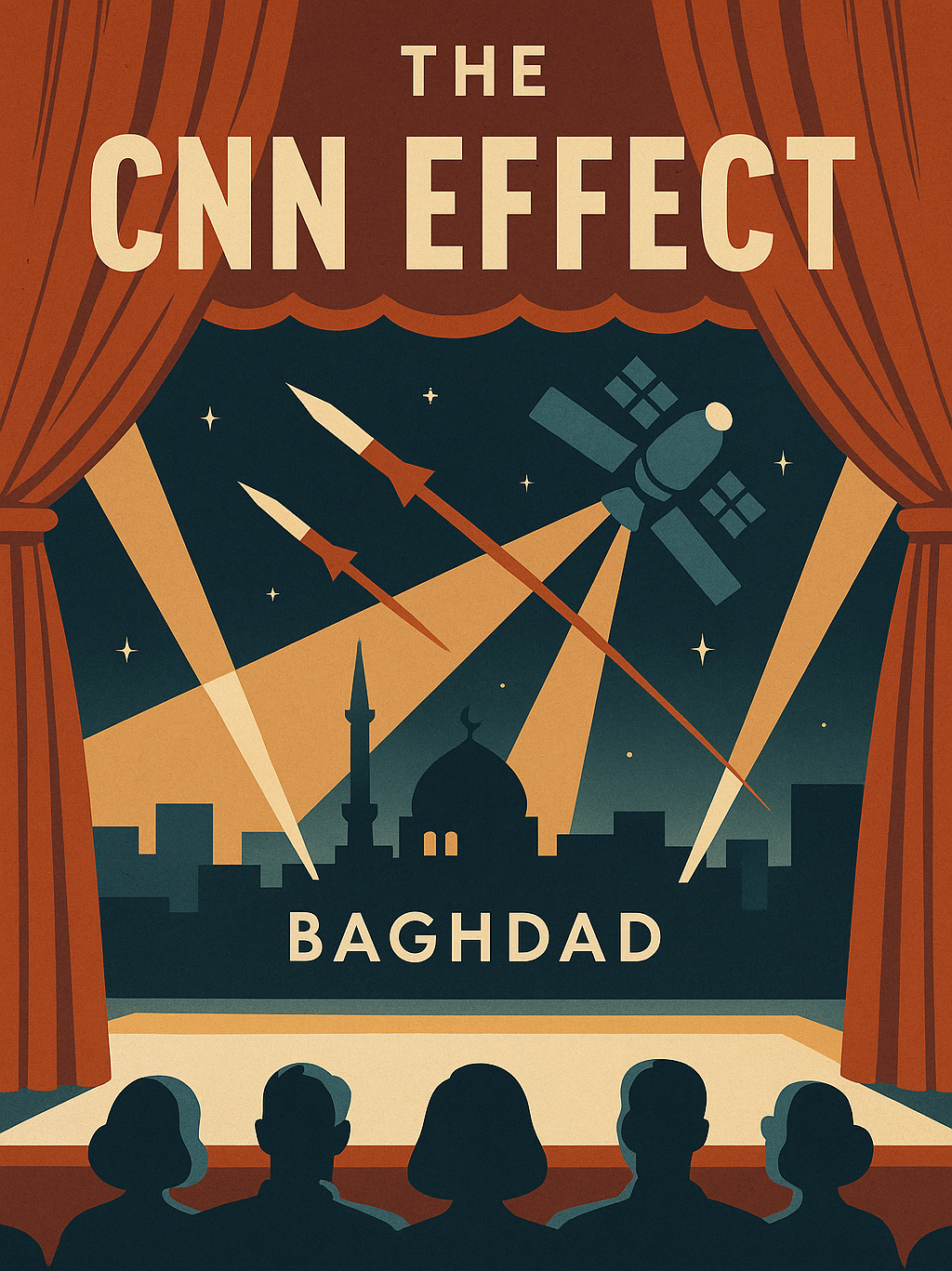
In several cases, yes.
The Gulf War made certain military systems unusually visible. Patriot missiles, stealth aircraft, precision-guided weapons and other capabilities appeared repeatedly in television news. For audiences outside defense circles, technologies previously discussed mostly by specialists suddenly became recognisable symbols associated with the conflict.
That visibility contributed to a wider perception of American technological advantage.
The coverage of the 1991 Gulf therefore had consequences beyond military reporting. It affected how the public understood the technological character of modern warfare.
But television also compressed nuance.
A successful intercept shown repeatedly could not explain an entire system’s operational record. A precision-strike video could not communicate every target-selection issue, failure or civilian consequence associated with the wider campaign.
Media visibility simplifies.
That is precisely why aerospace and defense brand strategy requires more than dramatic proof points. A credible technical company needs to explain what the system does, where it works, what evidence supports it and what limitations or operating conditions matter.
The Gulf TV war demonstrated the persuasive power of visible technical performance.
It also demonstrated why technical performance should not be reduced to spectacle.
What Happened to War Coverage After the 1991 Gulf War?
By the 2003 Iraq War, the media landscape had already become more fragmented.
The 24-hour television model remained important, but websites were growing, embedded journalism created a different relationship between reporters and military units, and more media outlets competed to define the coverage of the war.
The 2003 Iraq War made the limits of any single news network clearer. CNN remained influential, but audiences could move between cable television, international broadcasters, websites and alternative media.
The media environment became more distributed.
That fragmentation accelerated as digital platforms developed. Governments, civilians, soldiers, journalists and institutions gained more ways to publish directly. The information system increasingly shifted away from one news organization controlling the dominant live channel.
The Persian Gulf TV war therefore sits at an interesting point in communication history.
It came after the television era associated with Vietnam but before the networked information environment that defines modern conflicts.
CNN’s coverage was not the final evolution of live war communication.
It was the moment when a global audience saw just how powerful continuous live coverage could become.
What Can Defense Brands Learn From CNN Coverage Without Copying Wartime Propaganda?
The most useful lesson concerns translation.
A technical organisation may possess extraordinary capability, but an audience still needs a structured way to understand why that capability matters. During the Gulf War, television repeatedly connected technology with visible outcomes. That connection helped create public perceptions of speed, precision and technological advantage.
Modern defense companies can learn from the communication structure without pretending commercial marketing is equivalent to wartime information management.
A credible defense brand needs disciplined language, evidence, context and a clear position.
It also needs consistency.
That is why brand consistency in defense matters across websites, leadership communication, proposals, trade shows, press releases and case studies. Each interaction should reinforce an understandable strategic position rather than create another unrelated version of the organisation.
The second lesson is speed.
CNN’s breakthrough demonstrated what happens when the information environment accelerates. Companies today operate inside an even faster system. A technical failure, test result, executive comment or customer announcement can travel through digital channels long before a traditional approval process has completed its first meeting.
The answer is not absolute narrative control.
That was never realistic.
The answer is enough internal clarity that the organisation can communicate coherently when events move faster than the communications plan.
How Did Gulf War Media Coverage Change the Relationship Between Power and Public Perception?
The 1991 Gulf War demonstrated that military capability and public communication could no longer be treated as completely separate phenomena.
The coalition went to war against Iraq after Iraqi forces occupied Kuwait. Military outcomes depended on operational planning, intelligence, logistics, air power, ground forces, diplomacy and coalition cohesion.
Public understanding depended on another system.
Which reporter had access?
What could a journalist verify?
Which images reached television?
How did the news media explain those images?
What did Iraqi officials say?
What did coalition officials show?
How quickly did each claim move?
Those questions shaped media coverage of the Gulf even though they did not determine what happened on the battlefield.
The distinction remained important at the end of the war. A decisive military outcome did not erase questions around civilian consequences, press controls, regional politics or the longer history of Iraq.
Communication can amplify credibility.
It cannot permanently manufacture credibility when reality moves in the opposite direction.
Our analysis of WWII propaganda and defense branding explores an earlier version of the same problem, when governments used posters, industrial imagery, symbols and mass communication to shape public understanding of national power, sacrifice and military production.
The communication technology changed dramatically between World War II and the Persian Gulf War.
The underlying problem did not: complex institutions still needed to make power, technology and strategy intelligible to a mass audience.
Key Takeaways
- The Gulf War did not invent television war coverage, but CNN demonstrated the impact of continuous global reporting during a major conflict.
- CNN correspondents reporting from Baghdad helped turn the opening of Operation Desert Storm into one of the defining television moments of January 1991.
- The CNN effect describes the pressure created when rapid media coverage becomes part of the political and diplomatic decision environment.
- Live coverage did not equal unrestricted journalism. Restrictions on press coverage and the media pool system influenced what reporters could independently observe.
- Television coverage repeatedly highlighted precision weapons, aircraft and technological capability, influencing the public view of the war.
- The 1991 Gulf War coverage differed from Vietnam not simply because the conflicts were different, but because the media system had become faster, more continuous and more globally connected.
- Operation Desert Storm demonstrates how a memorable verbal frame can organise an extremely complicated event in public memory.
- Defense technology gained enormous public visibility during the conflict, but television imagery could also flatten technical and operational nuance.
- By the 2003 Iraq War, CNN no longer occupied the same singular position because the media system had become substantially more fragmented.
- Defense companies should learn from the information structure, not imitate wartime propaganda: connect technical capability with meaningful outcomes and support those claims with credible evidence.
- Real-time communication makes internal clarity more valuable because organisations have less time to reconcile inconsistent messages once information becomes public.
- The history of war coverage—from the Spanish-American War and Vietnam through the Persian Gulf War and later digital conflicts—shows that communication technology continually changes how power is perceived.
- Deep tech companies do not need to be dumbed down; they need to be translated. The Gulf War remains a useful historical example of how media can shape the meaning attached to complex technology, institutions and events.