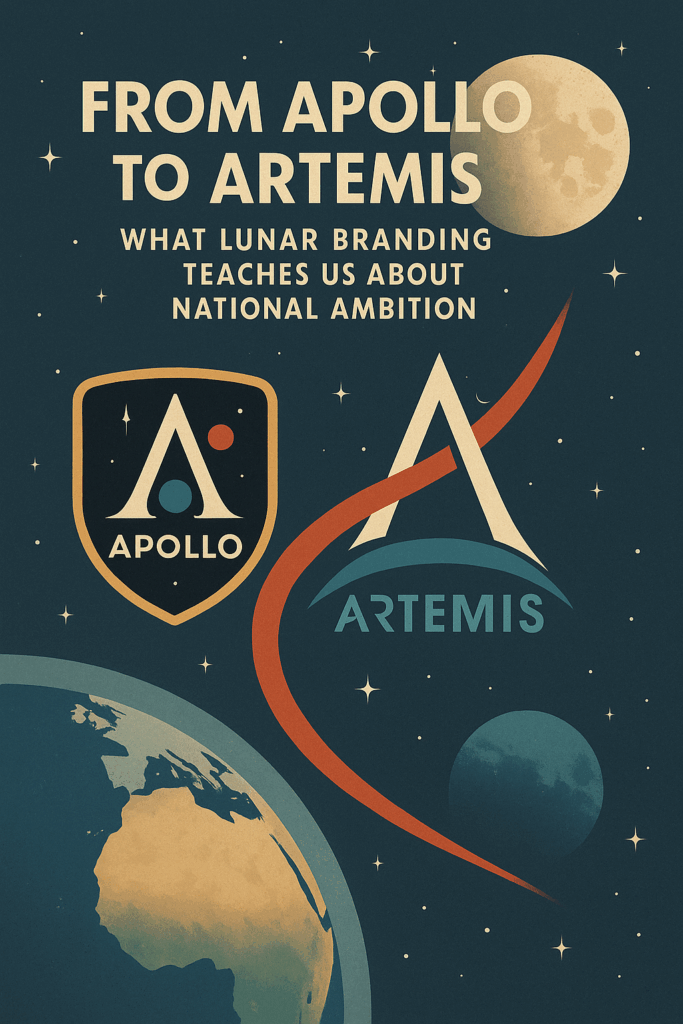


NASA has never had the luxury of communicating only with engineers.
Its programs have to make sense to astronauts, scientists, politicians, international partners, contractors, taxpayers, students and people who may understand almost nothing about orbital mechanics but understand perfectly well that sending humans hundreds of thousands of kilometres from Earth is difficult.
That is what makes lunar branding so interesting.
The technical achievement may be the reason the program exists, but symbols, language and visual structure help everybody else understand what that achievement means. Artemis provides an unusually good example because it connects mythology, exploration, infrastructure, international collaboration and technology into one recognisable system.
For deep-tech founders, there is a useful principle underneath all of this: deep tech companies do not need to be dumbed down; they need to be translated.
NASA does not make the engineering less sophisticated so people can follow it. It creates multiple layers of meaning around the engineering so different audiences can find an entry point.
That is the lesson worth stealing.
Article outline
- What does a space program need its identity to communicate?
- Why did Apollo make landing on the Moon culturally significant?
- Why does the name Artemis carry so much strategic meaning?
- What does the Artemis visual system actually communicate?
- How did Artemis II turn symbolism into visible proof?
- Why do Gateway and infrastructure change the narrative?
- How do commercial and international partners expand the system?
- Why do patches and emblems matter in technical organisations?
- How does NASA maintain relevance across decades?
- What should deep-tech companies learn from lunar exploration?
What Does a Lunar Brand Need to Communicate Beyond the Mission?

A space program has an unusual communication problem. Its technical complexity is enormous, its timelines are long, its audiences are fragmented and many of the most important things it builds cannot be experienced directly by the public.
That makes communication architecture important.
The public may never interact with a propulsion system, lander or rover. What they encounter instead are photographs, diagrams, crew interviews, animations, patches, names, launch footage and explanations of what the program is trying to accomplish.
Those pieces need a structure.
They have to connect engineering activity with a larger reason for caring.
This is similar to the problem technical founders face when developing a deep tech brand strategy. An internal team may understand exactly why a capability is technically significant while the market sees an impressive collection of specifications with no obvious hierarchy.
The strategic job is therefore to define what somebody should understand first.
NASA does this through multiple layers. Scientific discovery provides one layer. American leadership provides another. International cooperation adds another. The ambition to develop technology for sustained exploration adds another still.
The identity holds those ideas together.
It does not need to explain every component.
It needs to create enough clarity that people understand what the larger endeavour is moving toward.
Why Did Apollo Make Landing on the Moon More Than a Technological Achievement?
The Apollo program is a useful starting point because the physical accomplishment and the symbolic accomplishment became almost impossible to separate.
Landing on the Moon demonstrated extraordinary technological capability during the Cold War, but the images surrounding Apollo gave that capability cultural meaning. The spacecraft, astronauts, flag, Earth photography and program insignia became part of the public memory of the event.
The engineering happened once.
The imagery has been repeated for decades.
That is a fundamental principle of symbolic communication: moments pass, but well-constructed symbols can preserve their meaning long after the original event has ended.
Apollo also benefited from a remarkably clear narrative.
There was a destination.
There was a competitive context.
There was a specific objective.
There was visible risk.
And there was a result that almost anyone could understand without an engineering degree.
That combination made the achievement unusually easy to communicate.
Modern aerospace companies rarely have something as spectacular as landing on the Moon to work with, unfortunately. Most quarterly product releases are slightly less cinematic.
But the principle transfers.
If you want the market to remember an engineering milestone, connect it with a change people can understand.
What was impossible before?
What became possible afterward?
Why does that difference matter?
Our guide to aerospace storytelling frameworks applies this directly to technical businesses. The engineering remains important, but the narrative determines whether its significance travels beyond the engineering team.
Why Does the Name Artemis Matter So Much?
Naming creates interpretation before somebody encounters the technical detail.
The name Artemis deliberately connects the new program with Apollo through Greek mythology. Artemis is Apollo’s twin sister and became associated with the Moon, giving the new program an immediate relationship with the previous era without simply calling it “Apollo 2,” which would have been accurate in roughly the same way that naming a new aircraft “Old Aircraft Again” would be accurate.
That connection gives the program continuity.
Apollo becomes the historical reference point.
Artemis signals another chapter.
But the newer identity also allows different themes to enter the narrative, particularly broader participation, international collaboration and a different model of exploration.
This is useful brand architecture.
The past provides equity.
The new name creates room for evolution.
Technical companies often face exactly this problem during repositioning. They want to preserve credibility earned through an earlier product or market while showing that the organisation has moved somewhere new.
The answer is not always to erase the past.
Sometimes the stronger move is to create a visible relationship between what established credibility and what now defines the future.
That is also why aerospace rebrand storytelling works best when transformation has continuity. A new identity becomes more believable when the audience can see why the company evolved rather than being asked to forget everything it knew last Tuesday.
What Does the Artemis Logo and Design Actually Communicate?
The visual system is unusually disciplined because its elements have specific jobs.
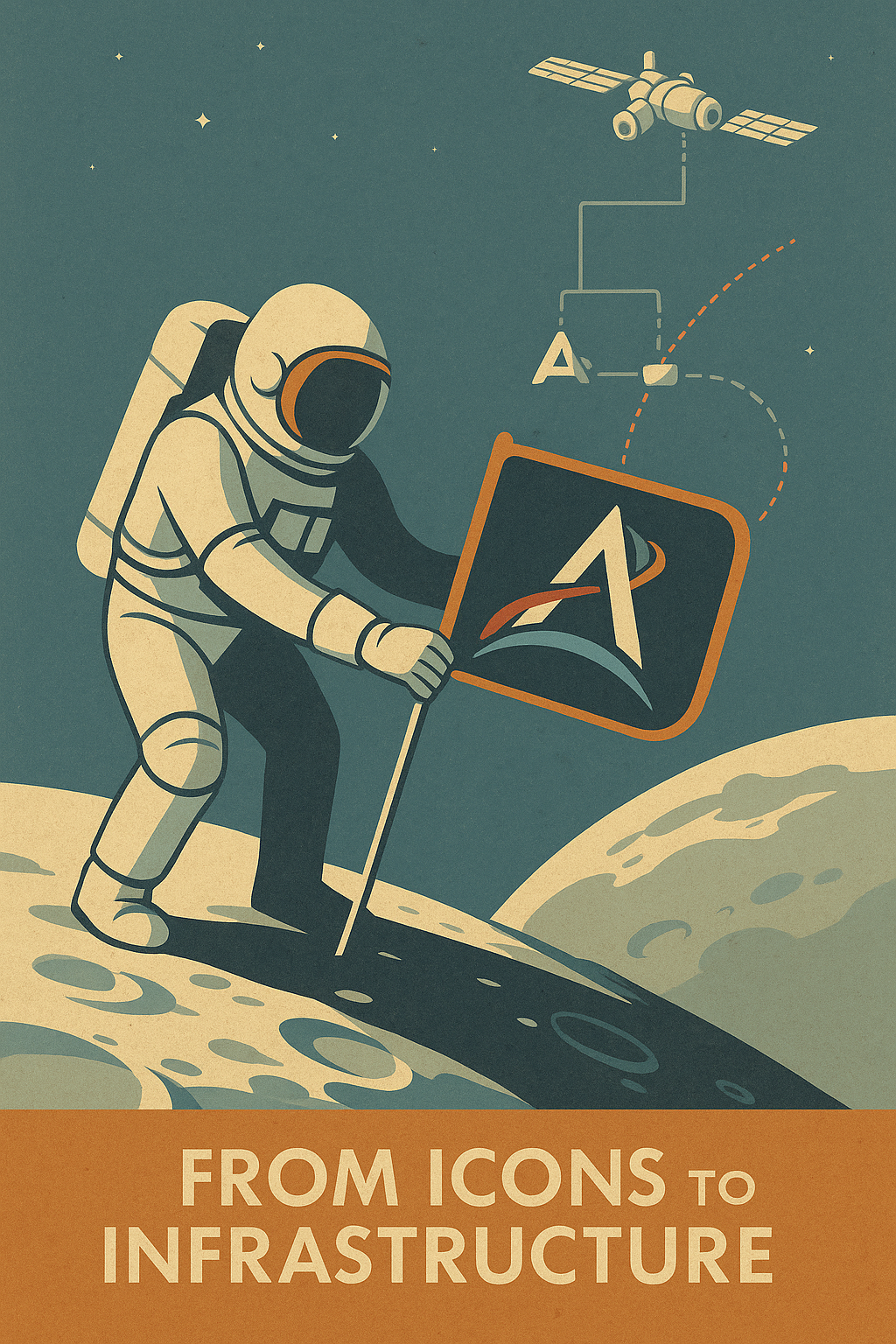
NASA explains the logo through several connected symbols. The central “A” references an arrowhead from Artemis’s quiver and points beyond the immediate destination. A blue Earth crescent places the journey from humanity’s perspective. A red trajectory cuts across the mark in the opposite direction from Apollo’s path and points toward Mars. The Moon provides the immediate destination.
That is good design because the explanation reinforces the strategy rather than existing as decorative mythology created after the artwork was finished.
The symbol communicates departure, direction and continuation.
It does not simply stylize a rocket.
The visual language also demonstrates something technical companies often miss: every element does not need to represent a separate corporate value.
There is restraint.
The system has enough meaning to reward attention without requiring viewers to memorise a diagram explaining why every pixel represents “innovation, excellence, trust, courage, synergy and customer-centricity.”
A cohesive visual identity should work the same way.
The identity needs to reinforce the strategic idea.
It should not become an archaeological dig in which every shape has been assigned twelve explanations because somebody felt uncomfortable leaving white space alone.
The strongest visual systems create meaning through repetition, hierarchy and precision.
How Did Artemis II Turn Symbolism Into Visible Proof?
Symbolism is valuable until reality arrives.
Then reality has to do the heavy lifting.
In April 2026, Artemis II completed the first crewed flight of Orion, carrying NASA astronauts Reid Wiseman, Victor Glover and Christina Koch together with CSA astronaut Jeremy Hansen on a nearly ten-day journey around the Moon.
That matters from a communication perspective because the program stopped being represented only through concepts, hardware testing, renderings and future ambition.
People could watch a crew participate in it.
The abstract became human.
This is an important distinction for technical brands.
Visual identity can create expectation.
Narrative can make the technology understandable.
Promotional communication can create visibility.
But a real operational milestone converts those promises into evidence.
The strongest companies understand that evidence should then be fed back into the communication system.
A first flight, successful deployment, certification milestone or customer outcome changes what the company is entitled to say.
The language can become more confident because something tangible now supports it.
That is how credibility compounds.
You do not build trust by repeatedly claiming to be credible.
You demonstrate something difficult, explain why it matters and allow the audience to update its perception.
A stellar visual system can help people remember the proof.
It cannot replace it.
Why Do Gateway and Lunar Infrastructure Change the Story?
Apollo is remembered primarily through individual events.
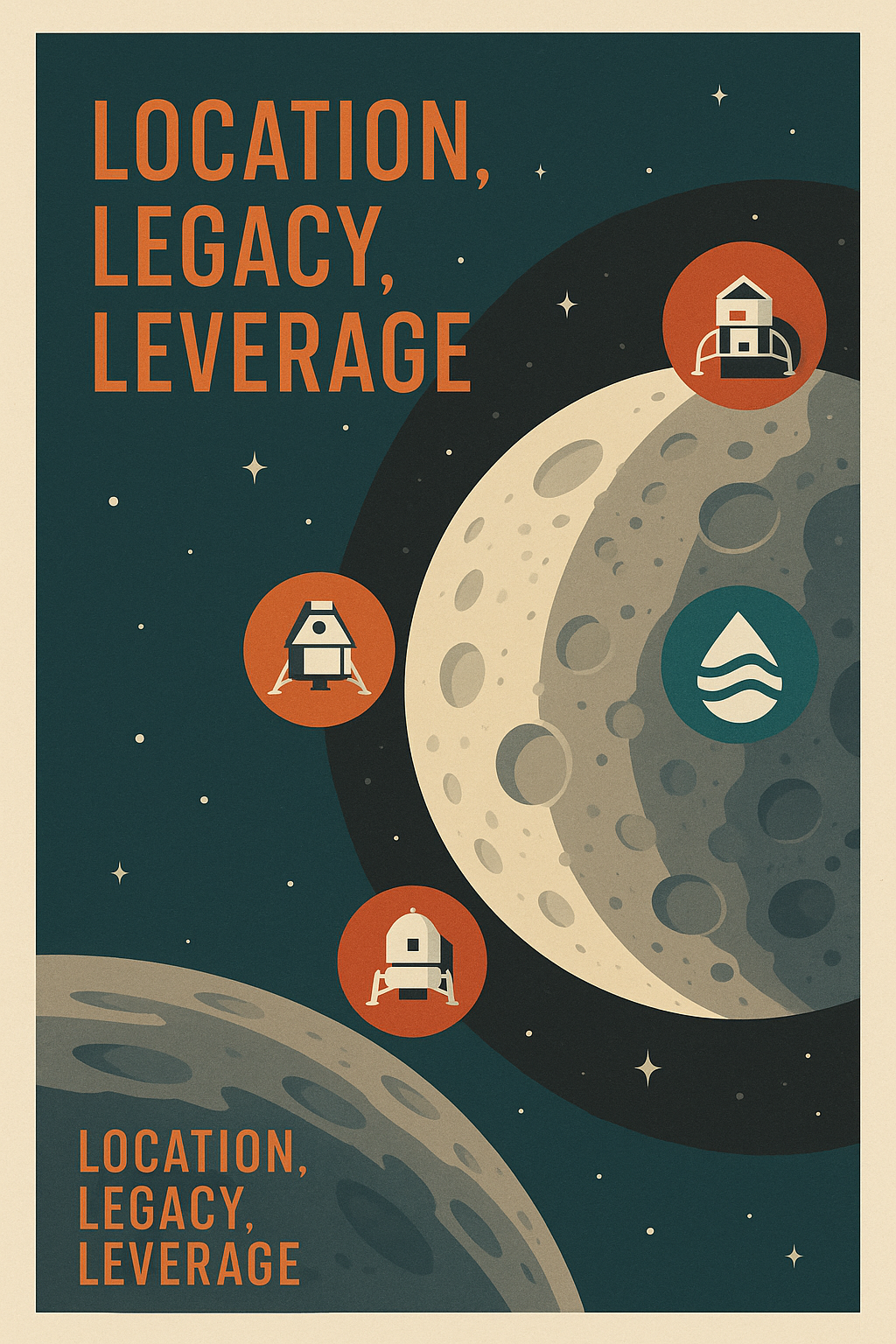
The newer architecture is increasingly explained as a system.
That distinction matters.
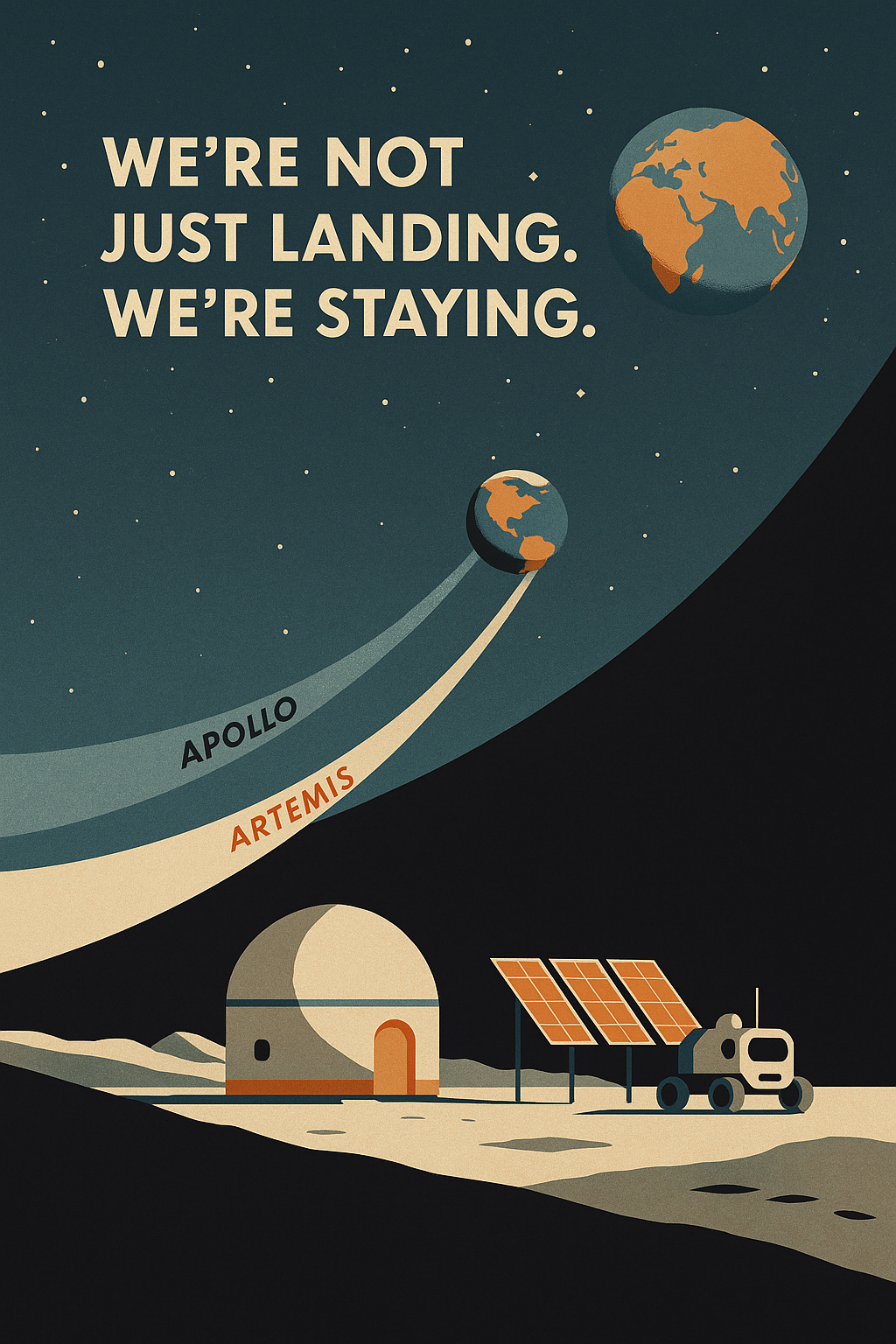
Gateway is intended as a small space station in lunar orbit supporting research, visiting spacecraft and future surface activity. NASA describes it as infrastructure for sustained exploration rather than simply another destination.
From a communication perspective, that moves the narrative from “Can humans get there?” toward “What does a durable human presence require?”
Those are very different questions.
An outpost, power systems, communications, surface equipment, logistics and an orbital platform are less emotionally immediate than planting a flag.
But they represent something strategically larger: repeatability.
This is where long-term programs become harder to communicate.
A spectacular landing produces an obvious hero image.
Infrastructure produces systems.
Systems require diagrams, explanations and visualisation.
But that can become an advantage if the communication is structured properly. Instead of presenting one enormous event, the organisation can show a sequence of capabilities being established over time.
Each component becomes part of a larger architecture.
For a deep-tech business, the analogy is useful.
A company may begin with one breakthrough product, but the more valuable story eventually becomes the ecosystem around it: integrations, data, infrastructure, service, partnerships and expansion.
That shift from product to system changes how the market values the company.
The communication needs to evolve with it.
How Do SpaceX, International Partners and Industry Infrastructure Expand the Artemis Story?
Large technical programs increasingly depend on networks rather than single institutions.
NASA remains the central space agency, but the wider Artemis architecture incorporates commercial providers and international participants. SpaceX and Blue Origin are part of NASA’s commercial lander development, while other agencies contribute technology, modules, expertise and operational capability.
That creates a broader communication system.
The program is no longer represented only by what one organisation can build.
Its credibility also comes from the ability to manage a sophisticated network of public and private capability.
That makes partnership part of the identity.
For industry, this is particularly important because complex technology companies rarely win by acting as isolated islands.
A spacecraft depends on systems.
A lander depends on other systems.
Surface activity may involve a mobile platform, science equipment, communications, power and eventually more sophisticated logistics.
The public-facing story becomes a way of showing how those pieces connect.
Technical companies should notice this.
When partners materially strengthen your ability to deliver, communicate the architecture rather than collecting logos on a “Partners” page and hoping the visitor performs the strategic interpretation alone.
Explain who contributes what.
Explain how the system becomes stronger.
Explain why the relationship matters to the customer.
That turns partnership from corporate swag into strategic evidence.
Why Do a Patch and Emblem Matter in an Engineering Culture?
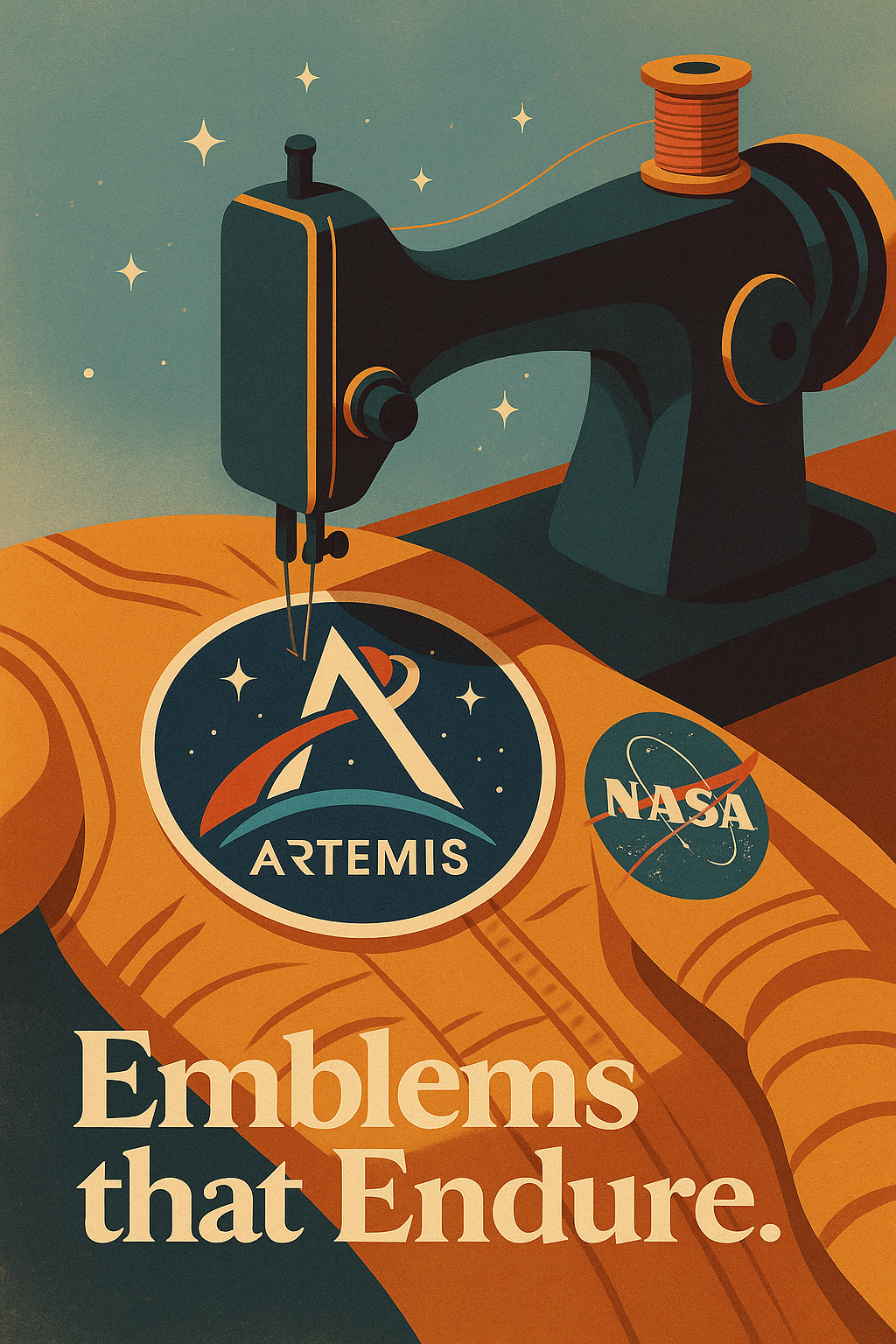
Mission identifiers have an interesting internal function because they are not designed only for outside audiences.
A patch can become a compact representation of something a team has spent years building.
That matters in organisations where thousands of individual decisions contribute to one eventual outcome.
The emblem creates shared reference.
People in different technical disciplines can identify with the same program even if their day-to-day work looks completely different.
An engineer working on software and somebody responsible for propulsion do not share the same task.
They can still share the same objective.
Symbols help maintain that alignment.
This is one reason brand identity should not be dismissed as external marketing.
A good identity can help an internal organisation understand itself.
It can unify teams around a common direction and make abstract strategy easier to carry into everyday work.
For businesses in the aerospace and defense sector, that becomes important as the organisation grows. Leadership cannot personally explain the strategy to every new employee, supplier or partner.
A clear symbolic and verbal system gives the organisation something repeatable.
Not a substitute for leadership.
A tool for extending it.
How Does NASA Sustain Relevance Across a Long-Term Exploration Program?
Technical projects create a branding challenge because engineering timelines and public attention operate at completely different speeds.
People want progress now.
Space hardware has an annoying habit of requiring testing.
A long-term program therefore needs enough milestones to sustain attention without pretending every development is history’s greatest breakthrough.
This is where Artemis has a useful structural advantage.
Different flights, crews, infrastructure components, scientific activity and hardware developments create multiple opportunities to demonstrate progress. Each can be communicated as part of the larger pathway rather than treated as an unrelated announcement.
The key is continuity.
The audience should understand where the latest development fits.
That is more useful than simply saying something is “bold,” “transformational” or “next-generation.”
The same principle applies when technical businesses communicate product development.
A new feature should relate to the larger value proposition.
A partnership should relate to market strategy.
A funding round should relate to what the capital allows the company to build.
A new office should relate to customer demand or capacity.
This creates relevance through progression.
You are showing movement rather than manufacturing excitement.
And that is usually more credible.
What Can Deep-Tech Companies Learn From Lunar Exploration Before They Launch Their Brand?
The first lesson is to separate technical complexity from communication complexity.
They are not the same thing.
Your product can remain extraordinarily sophisticated while the explanation becomes considerably clearer.
That is the essence of translation.
The second lesson is to create hierarchy.
NASA does not attempt to explain every subsystem in the first sentence. Different audiences can enter at different levels: public ambition, scientific discovery, engineering, international cooperation or technological capability.
A complex company needs the same layered structure.
The homepage communicates the main problem and value.
Technical pages provide depth.
Case studies demonstrate proof.
Leadership communication gives context.
Documentation handles the detail.
The third lesson is to make symbolism accountable to reality.
You can design an ambitious identity, but the company eventually has to demonstrate the capability behind it.
If you want to launch your brand around precision, the operation needs to be precise.
If you position around simplicity, the customer experience cannot feel like assembling a spacecraft from memory.
If you communicate sustainability, the claim needs evidence.
The fourth lesson is to think beyond the individual product.
A company may initially need to sell a product, but the strongest strategic position may eventually come from the infrastructure, expertise, partnerships and systems surrounding that product.
The fifth lesson is continuity.
Apollo and Artemis are different, but the newer identity draws power from the older achievement rather than pretending history began with a new PowerPoint template.
Technical businesses can do the same.
Preserve the equity that still matters.
Update what no longer reflects reality.
Then use the new system to connect where the company came from with what it is now capable of becoming.
What Should You Remember About Artemis, NASA and Lunar Brand Strategy?
- Lunar communication works because it translates complex engineering into symbols, stories and milestones that different audiences can understand.
- Apollo demonstrated how a technological achievement can become a cultural symbol when imagery, language and historical context reinforce one another.
- Artemis uses mythology to create continuity with Apollo while giving the newer program room to express a different era of exploration.
- The visual system works because its individual elements reinforce direction, destination and continuation rather than acting as decoration.
- Artemis II gave the identity new credibility by connecting years of future-facing communication with a real crewed flight.
- Gateway changes the narrative from isolated visits toward infrastructure and repeatable capability.
- Commercial and international participation expands the story from one institution’s engineering capability into a broader technical ecosystem.
- Patches and symbols matter internally because they help large teams connect specialised work with a common objective.
- Long programs need communication architecture that turns individual milestones into visible progression.
- The best technical identities create multiple levels of understanding rather than forcing every audience through the deepest engineering explanation first.
- Symbolism should support proof, never substitute for it.
- Technical companies should preserve useful historical equity when they evolve instead of reflexively erasing everything that came before.
- Design creates more value when it helps people understand strategic structure, not when it merely makes complexity look attractive.
- The central principle remains the same: deep tech companies do not need to be dumbed down; they need to be translated. NASA’s lunar communication is useful because it shows how engineering, symbolism and evidence can work together without requiring the engineering itself to become any less sophisticated.